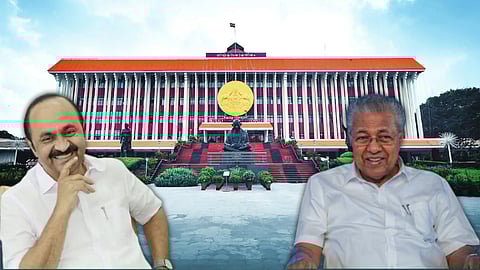

With Kerala’s next Assembly elections a few months away, betting has already begun in the United States on who will emerge victorious. Traders on Polymarket, a popular US-based prediction market, are currently giving the Congress-led UDF a 70% chance of winning, while the CPI(M)-led Left front is assigned a 28% probability.
Polymarket gained widespread attention in the US in the run-up to the 2024 US presidential elections. However, the platform is not limited to political outcomes alone. Traders also place money on a wide range of unusual and sometimes absurd outcomes, ranging from economic indicators to questions such as how long Donald Trump might shake a foreign dignitary’s hand or what colour tie he could be wearing at a public event.
“Polymarket is a prediction market where people trade on what they think will become true in the future, be it in politics, sports, or pop culture, using crypto,” says Jose Paul, founder of Bitmor, a crypto startup.
Instead of placing a traditional bet, users buy ‘Yes’ or ‘No’ shares for a specific outcome. Once the event concludes, the market resolves. Each correct share pays $1, while incorrect shares become worthless.
“That’s why Polymarket prices read like probabilities. If a ‘Yes’ share is trading at 70 cents, the market is effectively saying there is roughly a 70% chance that the outcome will happen, and traders are paying 70 cents today for the right to receive $1 if it does,” he explains.
Participants on Polymarket are referred to as traders because they can buy or sell their positions at any time before the final outcome. This allows them to lock in profits, cut losses, or adjust their exposure, much like in stock markets.
The market for the Kerala Legislative Assembly election winner began trading on December 23, 2025. So far, bets worth about $4,770, approximately ₹4.3 lakh, have been placed on the outcome.

Supporters of prediction markets argue that the presence of real money encourages more honest assessments than traditional opinion polls, as traders have a financial incentive to be right rather than merely express an opinion.
However, while Polymarket attracted massive participation during the US presidential election, with total trading volumes crossing $3.6 billion, the Kerala Assembly election market remains extremely small by comparison. With relatively low trading volumes, even a few large bets can significantly sway the odds.
As a result, the probabilities reflected in this market are best read as an early snapshot of sentiment rather than a reliable forecast, and should be interpreted with a degree of caution.
