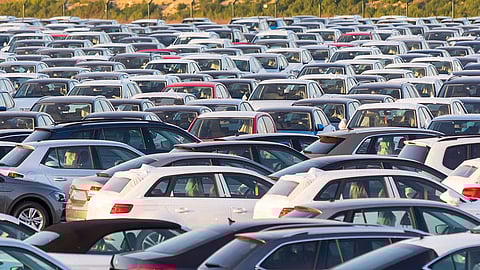

Car buyers are increasingly moving back to combustion engines, driven by policy reversals, trade wars, and growing doubts over the practicality of electric vehicles (EVs). A report released by professional services group EY on Tuesday revealed that half of global car buyers plan to purchase a gasoline-powered vehicle within the next two years, a significant rise of 13 percentage points compared to 2024. The preference for EVs and hybrids has dropped sharply, with only 14% and 16% of buyers considering these options, respectively.
This trend is most evident in Western countries, where major policy changes are pushing back the transition to electric transport. In the U.S., President Donald Trump’s proposal to cut fuel economy standards is seen as a lifeline to the struggling gasoline-powered car market. Meanwhile, the European Union is considering a softer version of its 2035 phase-out of combustion engines, following a slower-than-expected transition to electric vehicles.
EY's Global Aerospace, Defense and Mobility Practice Leader, Constantin M. Gall, noted that these policy changes come as the shift to electric vehicles has not progressed as quickly as anticipated. Despite China’s lead in EV adoption, Gall pointed out that Chinese buyers are more focused on the integration of digital features in their vehicles than on the energy source itself.
However, the situation is markedly different in India, where the electric vehicle market is booming. In stark contrast to the global downturn in EV sales, India has seen its EV retail sales cross the 2-million mark for the first time in 2025, driven largely by a surge in two-wheeler and three-wheeler sales. Retail sales of electric two-wheelers alone reached around 1.17 million units, contributing to 58% of total EV volumes. Three-wheelers followed with 696,150 units sold, making up 34% of EV sales.
The shift towards electric mobility in India is supported by a widening array of EV models, growing consumer interest, and the entry of traditional manufacturers like TVS and Bajaj, which have dominated the conventional two-wheeler market. The expected entry of Maruti Suzuki’s first mass-market electric car is set to further accelerate adoption, alongside Tata Motors and Mahindra, which remain key drivers of growth in the electric passenger vehicle segment.
Despite the slowdown in global EV adoption, India’s market shows no signs of slowing down. With sales expected to surpass the 2-million mark for 2025, India’s EV market is an outlier, bucking the global trend. While the global shift back to combustion engines is prompted by economic pressures and policy reversals, India’s adoption of electric vehicles is driven by a combination of strong demand, government incentives, and a rapidly expanding model lineup.
Globally, the shift back to combustion engines is partly a reaction to geopolitical and economic factors, with a growing sense of skepticism around the sustainability of EV infrastructure and costs. While Western carmakers advocate for a slower phase-out of fossil fuels to ensure the industry’s survival, environmental groups argue that a swift transition to electric vehicles is necessary to combat climate change and reduce CO2 emissions. The U.S. and European policymakers have even implemented measures, including import tariffs, to protect their markets from China’s heavily subsidized electric vehicles, further complicating the EV landscape.
As the global car market faces a turning tide with rising interest in gasoline-powered vehicles, India’s electric vehicle market is defying the odds. With robust growth in two-wheeler and three-wheeler sales, and increasing interest in electric passenger vehicles, India’s EV sector continues to thrive, setting itself apart from the global trend.

