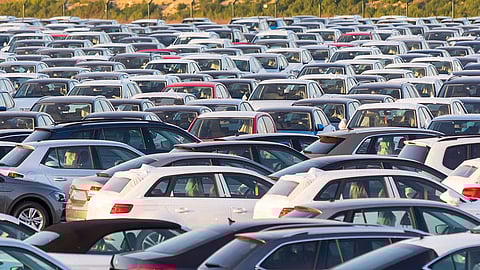

Passenger vehicle retail sales rose 7.22 percent year-on-year in January to 5,13,475 units, powered largely by a strong showing in rural markets, according to data released by the Federation of Automobile Dealers Associations (Fada) on Tuesday.
Overall automobile retail sales, including passenger vehicles, climbed 17.6 percent to 2.72 million units during the month. Fada attributed the broad-based growth to sustained post-GST momentum, healthy rural cash flows supported by harvest activity and wedding-season spending, and steady demand visibility across personal mobility and freight.
While the passenger vehicle market continues to be urban-led, with cities accounting for 59.2 percent of sales, rural India now contributes a sizeable 40.8 percent. Importantly, rural markets recorded a growth of 14.4 percent in January, sharply outperforming the 2.75 percent expansion seen in urban centres.
Fada said this trend underlines the gradual widening of passenger vehicle demand beyond major cities, supported by a strong preference for SUVs and compact SUVs, a revival in entry-level cars, better product availability and continued dealer-led schemes.
January also saw heightened competition among carmakers. Hyundai Motor reclaimed the second position after several months, posting a market share of 12.84 percent with retail sales of 65,914 units. Tata Motors followed closely with a 12.38 percent share (63,558 units), while Mahindra & Mahindra was marginally behind at 12.34 percent (63,366 units).
Maruti Suzuki retained its leadership position with a dominant 42 percent market share. The company sold 216,043 units during the month, slightly higher than 214,494 units recorded in January last year.
Fada president C S Vigneshwar said passenger vehicle inventory levels continued to soften to 32–34 days, signalling healthier channel discipline and improved working-capital efficiency across dealer networks.
Two-wheelers remained the biggest growth driver, with retail sales rising 20.82 percent year-on-year to 18.5 lakh units. Rural markets accounted for 56 percent of two-wheeler demand, compared with 44 percent from urban areas.
Rural two-wheeler volumes grew 19.77 percent, supported by Pongal and Makar Sankranti festivities, wedding-related footfalls and improved affordability. Urban markets also showed a clear revival, registering a robust 22.19 percent growth, indicating demand normalisation beyond festival-led purchases.
Commercial vehicle retail sales rose 15.07 percent to 107,486 units, reflecting improving freight sentiment and replacement-led buying. Growth was seen across tonnage segments, with light commercial vehicles at 65,505 units and heavy commercial vehicles at 34,287 units, broadly aligned with stronger goods movement and infrastructure activity.
Three-wheelers remained resilient, posting an 18.80 percent growth during the month. In contrast, construction equipment sales declined 21.09 percent, reflecting a high-base effect and segment-specific adjustments.
Looking ahead, Fada expects passenger vehicle demand to remain steady, supported by a strong booking pipeline, new launches and variants, and continued GST-led affordability. However, high base effects, production constraints and ongoing inventory clean-up could result in more measured growth in the coming months.

