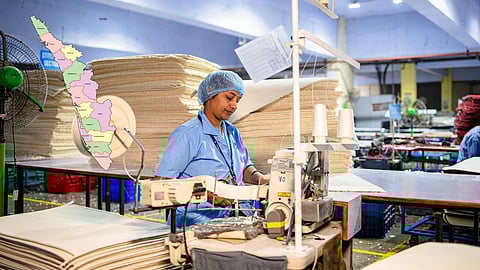

India’s MSME sector is routinely described as the backbone of the economy. The numbers justify that description. Micro, small and medium enterprises are among the country’s biggest employment generators, contribute substantially to GDP and account for nearly half of India’s exports.
But for thousands of small businesses in Kerala, the reality behind those numbers is far less encouraging.
From shortage of skilled workers and inadequate working capital to delayed payments, high electricity costs, land constraints and regulatory overlaps, MSMEs continue to face problems that directly affect their survival and competitiveness.
Industry representatives say many of these issues have remained unresolved for years. At the same time, new challenges linked to technology, digital systems and rising operating costs are adding to the pressure.
What does Keralam need to change to make its MSME ecosystem more competitive? Industry representatives argue that the sector's economic importance has not translated into an equally supportive business environment.
Their demands range from easier credit and industrial land availability to better skill development, faster government clearances and modernisation support.
Finding technically trained workers has become one of the biggest challenges for small manufacturers. Modern machinery often requires specialised skills, but employers say the supply of trained workers has not kept pace with industrial requirements.
Although ITIs, polytechnics and other technical institutions have undergone reforms, the sector feels more needs to be done to attract young people. Industry representatives want technical education to become more industry-oriented. They also suggest giving diploma-level technical courses greater academic recognition.
Another proposal is to establish district-level labour banks supported by an online portal. Such a system could connect industrial units directly with available skilled workers.
For a small enterprise, a delayed payment can quickly become a working capital crisis. MSMEs supplying goods and services to large companies and public-sector institutions often complain that payments are not received within agreed timelines.
The impact can be severe. A company may have orders on hand but still struggle to pay salaries, buy raw materials or service loans simply because receivables are stuck.
MSME Facilitation Councils are intended to resolve such disputes. Industry representatives, however, say Keralam needs more councils. Their demand is simple: establish one facilitation council in every district and speed up the settlement of delayed-payment disputes.
Access to credit remains another major concern. Many businesses manage to set up their units but later face difficulty in securing enough working capital to continue operations.
Entrepreneurs say bank lending procedures should be simplified and collateral requirements made more practical.
One statistic frequently cited by industry representatives is Keralam's credit-deposit ratio of 72.88%. This compares with 154.04% in Andhra Pradesh, 128.58% in Telangana and around 126% in Tamil Nadu.
The argument from Keralam's business community is that deposits mobilised within the state are not being converted into enough credit for local enterprises.
While institutions such as Kerala Financial Corporation offer comparatively affordable financing, entrepreneurs want similar lending support to be available on a wider scale.
One suggestion is an MSME working capital or gold loan scheme modelled on the Kisan Credit Card, with interest rates in the 5-6% range.
Industry representatives also flag delays in government assistance under the Entrepreneur Support Scheme since 2023.
For businesses with limited cash reserves, delayed financial support can become a question of survival rather than expansion.
Private industrial parks have emerged as one of Kerala's attempts to overcome the shortage of industrial land. But entrepreneurs say subsidy payments to these parks should be made without delay.
They also want the existing subsidy structure to be revised. At present, the upper limit is cited at ₹3 crore per industrial park. Industry groups propose replacing this ceiling with assistance of ₹30 lakh per acre without an overall cap.
They also argue that incentives available to larger industrial projects should, where feasible, be extended to MSMEs.
Industry representatives want Kerala to frame a dedicated building code for industrial units rather than relying primarily on the National Building Code.
States including Karnataka, Madhya Pradesh, Tamil Nadu and Telangana are cited as examples where more state-specific approaches have been adopted.
There is also a demand to simplify fire NOC requirements for smaller buildings inside industrial estates. One proposal is to exempt buildings of up to 24 metres in height and 20,000 sq ft in area, subject to appropriate safety norms.
Electricity is a major cost component for many manufacturing businesses. Industry representatives also point to differences in power supply norms between units inside and outside industrial parks.
Units within industrial parks can reportedly access low-tension supply of up to 150 kVA, while outside units face a lower limit of 100 kVA.
Businesses say this creates an unnecessary disparity.
Another major demand is financial support for rooftop solar installations. The sector wants solar systems at MSME units to be covered under the Entrepreneur Support Scheme.
Compliance remains another pain point. Entrepreneurs say provisions under the Single Window Clearance framework sometimes conflict with requirements under local self-government laws.
A clearance not required under one regulation may become compulsory under another.
The result is uncertainty, delays and additional compliance costs.
One of the most persistent complaints relates to land ownership inside industrial parks. Industry representatives say entrepreneurs have, in some cases, paid the full value of industrial plots but have still not received registered title deeds.
Questions also arise over ownership after long-term lease agreements expire. The industry estimates that such issues affect nearly 48 of the more than 116 industrial parks in Keralam.
Without clear land titles, businesses can face difficulty in raising loans, transferring assets or making fresh investments.
Keralam has several agencies working towards industrial development, including KSIDC, SIDCO, KINFRA and INKEL. Entrepreneurs argue that the presence of multiple institutions often makes the system difficult to navigate. They suggest better coordination or consolidation of overlapping functions.
Keralam's limited availability of industrial land remains a structural disadvantage. Industry representatives point out that several parcels of land continue to remain unavailable for development because of their classification in revenue records, even when they may no longer serve their original agricultural purpose.
They want eligible land to be reclassified through a faster, transparent process and made available for industrial use.
Some in the sector estimate that easier land access alone could increase the number of MSMEs in the state by at least 30%.
Another concern is the slow pace of technology adoption among smaller units. Many continue to depend on older machinery and production systems, which can reduce productivity and increase costs.
Industry representatives want institutional support to help companies identify and import suitable technologies from other countries.
They also stress the need for technically knowledgeable officials who can guide MSMEs through technology upgrades.
Entrepreneurs also complain about difficulties in using K-SMART.
Applications submitted through the platform can remain pending, while businesses may struggle to identify who is responsible for resolving the issue.
Industry representatives want the system to evolve into a more effective business facilitation platform with defined timelines and accountability.
Telangana's TS-iPASS is often cited as a model worth studying.
A Nisarudheen, president of the Keralam State Small Industries Association, points to the unresolved issue of land transfers in industrial parks. There are cases where entrepreneurs paid the government for industrial land decades ago but are still waiting for title deeds to be registered in their names.
KV Anwar, managing director of Modern Distropolis Ltd, Manjeri, wants government assistance for installing solar systems at MSME units through the Entrepreneur Support Scheme.
AV Sunilnath, managing committee member of the Confederation of Indian Footwear Industries, says lending procedures and conditions need to be simplified, particularly in the context of Kerala's comparatively low credit-deposit ratio.
Julia Rajesh, managing director of JR Creations (Mikoto), Kottayam, says local bodies should adopt a more supportive approach towards small-scale industries, particularly because of their role in employment generation. Easier access to working capital, she says, is equally important.
Keralam's MSME sector is not merely seeking more subsidies. Its larger demand is for a business environment that is predictable, responsive and easier to navigate.
Entrepreneurs want faster access to credit, skilled labour, industrial land, technology and government clearances. They also want existing schemes and institutions to deliver more efficiently.
For Kerala, where large-scale industrialisation faces obvious constraints, MSMEs have an especially important role to play in creating employment and driving decentralised economic growth.
The next phase of MSME growth may therefore depend less on announcing new schemes and more on fixing the bottlenecks that businesses have been highlighting for years.

