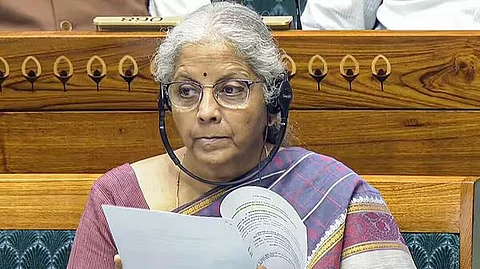

Union Finance Minister Nirmala Sitharaman has indicated that the government will take a cautious approach to taxation ahead of the next Union Budget. Her remarks come amid growing calls from market participants to review long-term capital gains (LTCG) tax and securities transaction tax (STT) on equity investments.
Speaking at an event in New Delhi on Tuesday, Sitharaman acknowledged concerns that LTCG and STT impose overlapping tax burdens on stock market investors.
She said several market participants had suggested retaining only one of the two taxes. The government, she indicated, was open to hearing investors' views before considering changes.
The Finance Minister's comments on capital gains taxation have raised expectations of a possible review ahead of the Union Budget.
The debate comes as foreign portfolio investors (FPIs) continue to withdraw money from Indian equities.
Foreign investors have pulled out ₹3,07,719 crore in 2026 so far, following withdrawals of ₹1,66,286 crore in 2025. In 2024, net foreign inflows were just ₹425 crore.
Persistent selling has affected market sentiment. The Nifty and Sensex have delivered five-year absolute returns of 23% and 18%, respectively, according to the figures cited in the report.
Sitharaman explained that the government's approach to taxation across asset classes was intended to bring greater uniformity rather than simply increase the tax burden on investors.
SBI Research has recommended abolishing LTCG tax on equity investments to attract foreign capital and encourage long-term investment.
In its latest Ecowrap report, the research wing of State Bank of India suggested extending the holding period for long-term equity investments from the current one year to two or three years.
The report comes amid sustained foreign investor withdrawals. SBI Research said cumulative FPI outflows from equities reached ₹3.51 lakh crore between 2021 and September 2026.
It also urged the government to address structural issues affecting foreign capital inflows, arguing that monetary measures alone may not be sufficient.
Addressing concerns over the rupee's depreciation against the US dollar, Sitharaman said external factors were contributing to currency volatility.
She indicated that the Reserve Bank of India could take further measures to manage excessive fluctuations. However, India would prefer the rupee to find its own market-determined level rather than maintain a fixed exchange rate.
The Finance Minister also highlighted India's efforts to attract global investment in artificial intelligence, semiconductor manufacturing and clean energy.
She noted that a significant share of global capital was flowing towards the US, particularly into AI infrastructure and large technology companies.
India, she said, wanted investment in both advanced AI development and practical applications that could improve business productivity.
The government is also seeking investment in semiconductor design, manufacturing, testing and packaging, along with renewable energy, power transmission, green hydrogen, green ammonia and electric vehicles.
Responding to criticism of India's semiconductor ambitions, Sitharaman said the country was taking a practical approach by focusing on chips used in automobiles, household appliances and connected devices, alongside more advanced technologies.
The Finance Minister's comments on capital gains taxation have raised expectations of a possible review ahead of the Union Budget. However, no specific tax changes have been announced.

