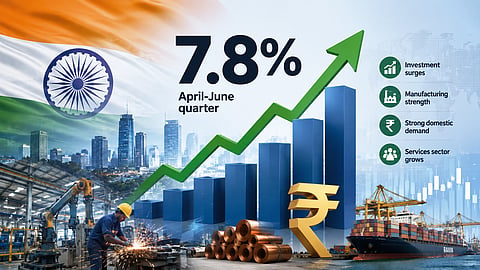

India’s economic growth came in much stronger than expected in the April-June quarter, with a sharp rise in private investment and robust manufacturing activity helping the economy withstand global uncertainties and elevated crude oil prices.
Real GDP grew 7.8% year-on-year in the first quarter of FY27. Although growth was slower than the revised 8.6% recorded in the previous quarter, the latest numbers point to continued strength in domestic demand.
One of the biggest positives was the acceleration in private investment.
Private investment growth nearly doubled to around 12%, from 5.8% a year earlier.
Personal consumption expenditure grew 7.1%, compared with 6.8% in the year-ago quarter.
Strong credit demand is supporting activity across agriculture, industry and services.
Bank lending grew 18.3% at the end of June, the fastest pace in more than a decade.
Tax reductions announced earlier also helped support consumer spending, adding to the momentum in domestic demand.
The manufacturing sector remained a major growth driver, expanding 9.2% in the April-June quarter, compared with 8.3% a year earlier.
Financial services also recorded strong growth of 12.1%, up from 8.8% in the corresponding period last year. The increase was supported by strong bank credit growth.
Gross value added (GVA), which provides a clearer picture of underlying economic activity by excluding the impact of indirect taxes and subsidies, increased 8.2%.
Despite the strong growth numbers, the outlook faces significant external risks. Crude oil prices remain close to $90 a barrel amid geopolitical tensions, posing a challenge for an economy that imports nearly 85% of its crude requirements.
Chief economic adviser V Anantha Nageswaran said higher petroleum prices could affect global demand and India's export prospects, making export diversification and cost competitiveness increasingly important.
Higher oil prices could also put pressure on inflation, the current account and government finances.
The monsoon remains crucial for rural demand and agricultural growth. The southwest monsoon accounts for around 70% of India's annual rainfall and has a direct bearing on farm output and rural incomes.
Agriculture grew 3.6% in the April-June quarter, matching the previous quarter's pace. However, a deficient monsoon could create both growth and inflation risks.
Economists believe India's domestic economy remains resilient despite global headwinds. Strong consumption, investment and credit growth could help keep full-year economic growth above 7%.
The key risks, however, are likely to come from high crude oil prices, a weaker rupee and tighter global financial conditions.

