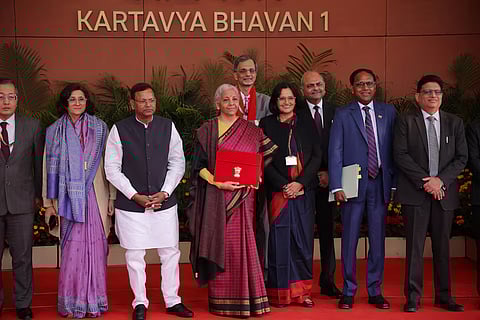

Finance Minister Nirmala Sitharaman opted for stability rather than headline-grabbing announcements, stressing that accelerating and sustaining economic growth remains the government’s foremost “kartavya” (duty), even as fiscal constraints become more evident.
The Budget for 2026–27 reflects a widening resource gap for the Centre amid weaker tax buoyancy and challenging global conditions. Despite this, the government continues to position itself as the primary driver of structural reform, investment and job creation.
Echoing the Economic Survey 2025–26, the Budget announced fresh measures to revive India’s manufacturing base, focusing on seven strategic and frontier sectors:
Textiles
Capital goods
Semiconductors
Rare earths
Electronic components
Biopharma
Additional allocations have been provided for semiconductors and biopharma, signalling a push to build domestic capacity in critical supply chains.
Structural diversification was further emphasised through plans to rejuvenate 200 legacy industrial clusters with infrastructure and technology support. The Budget also introduced “Champion SMEs”, with support extending beyond concessional credit to include direct equity funding.
Alongside a renewed thrust on services, these initiatives are aimed at boosting employment and tapping India’s demographic dividend.
Another notable initiative is the plan to develop Tier II and Tier III cities as growth engines. The government has earmarked Rs 5,000 crore each over five years for this effort.
This comes as India’s urban population is projected to reach nearly 600 million by 2035, requiring infrastructure investments of close to Rs 60 lakh crore over the next decade.
On the fiscal front, the deficit for FY27 has been pegged at 4.3 percent of GDP, marginally lower than the 4.4 percent target for the current year. The government outlined a medium-term strategy to reduce the Centre’s debt-to-GDP ratio to 50 percent by FY31, though the overall size of the Budget relative to GDP has been compressed.
Key fiscal indicators point to emerging strain:
Revenue deficit is projected at 1.5 percent of GDP in both FY26 and FY27
Interest payments are expected to absorb 49 percent of net tax receipts in FY27, up from 47.6 percent in FY26 (RE)
Gross market borrowing for FY27 is estimated at Rs 17.2 lakh-crore, slightly above market expectations
This raises the possibility of a modest rise in government bond yields.
Moody’s Ratings described the Budget as “tactical” rather than transformative, signalling limited near-term upside for India’s sovereign credit profile.
Tax buoyancy for FY27 is projected at 0.8x, based on nominal GDP growth of 10 percent. This is lower than the revised 0.9x for FY26 and well below post-pandemic levels, reflecting last year’s tax cuts and a waning impact of incremental tax effort.
On the expenditure side, subsidy spending is budgeted to decline to 1 percent of GDP from 1.2 percent this year, an assumption that appears to hinge on politically sensitive revisions to urea prices, last adjusted in 2018.
Capital expenditure is set to rise 9 percent to around Rs 12 lakh-crore, maintaining its share at 3.1 percent of GDP. Revenue spending remains tightly controlled, although defence allocations have increased following Operation Sindoor.
The disinvestment and asset monetisation target for FY27 has been set at Rs 80,000 crore, with Rs 35,000–40,000 crore expected from the strategic sale of IDBI Bank. Few other large transactions are currently visible.
The Budget avoided a broad customs duty rationalisation, opting instead for selective duty waivers on life-saving drugs and specific capital goods. Customs revenue growth is projected at 5 percent in FY27, down from 10.8 percent in FY26 (RE), reflecting tariff cuts and the growing impact of free trade agreements, including the recently concluded pact with the European Union.
Sitharaman announced relief for minority shareholders by taxing buyback proceeds as capital gains rather than at marginal income tax rates. To prevent arbitrage, an additional buyback tax will apply to promoters, with effective rates of 22 percent for corporate promoters and 30 percent for others.
Overall, the Budget underscores cautious continuity — prioritising investment-led growth and targeted reforms while navigating tightening fiscal headroom.

