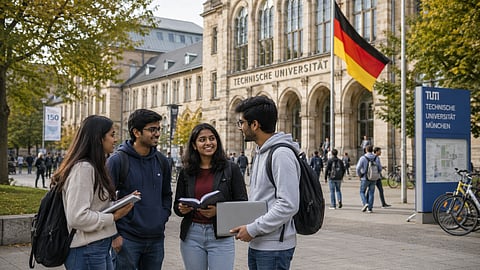

Europe is steadily replacing the United States as the preferred overseas education destination for Indian students, as lower tuition fees, better post-study employment prospects and a landmark India-European Union trade agreement reshape global education choices. While the US remains the single largest destination, education consultants say a growing number of Indian students are now actively choosing European universities over their American counterparts, signalling a major shift in international student mobility.
Several factors are driving the growing preference for European universities:
Tuition fees in many European countries are 50 to 80 percent lower than comparable programmes in the US.
Living expenses are generally lower, reducing the overall cost of higher education.
More universities now offer master's programmes entirely in English.
Students have access to wider employment opportunities across the European Union after graduation.
Europe offers a better work-life balance in several countries.
The trend is particularly visible among middle-class Indian families seeking internationally recognised degrees without the financial burden associated with studying in North America.
The India-EU trade agreement signed earlier this year is expected to accelerate student mobility between the two regions.
The agreement aims to create structured pathways for Indian students and professionals by:
Simplifying visa procedures.
Improving recognition of Indian academic qualifications.
Creating clearer post-study work opportunities.
Facilitating movement of skilled professionals across Europe.
Negotiating social security arrangements with EU member states over the next five years.
The European Union is also planning a technology-focused support office to guide Indian students and professionals exploring opportunities in Europe.
The agreement reflects Europe's growing need for skilled workers to address labour shortages caused by an ageing population.
Instead of selecting destinations solely based on reputation, Indian students are increasingly matching countries with their career aspirations.
Popular choices include:
Germany for engineering and manufacturing.
France for management education.
The Netherlands for technology careers and work-life balance.
Portugal for affordable postgraduate research.
Education consultants say Europe is no longer viewed as merely an alternative to the US but as a destination offering distinct academic and career advantages.
Europe's rise also coincides with growing uncertainty in traditional study destinations.
According to government data, the number of Indian students going abroad declined to around 6,26,000 in 2025 from more than 9,08,000 in 2023.
The decline is attributed to:
Rising tuition fees.
Higher living costs.
Tougher immigration policies.
Stricter student visa regulations.
Greater uncertainty over long-term work opportunities.
The United States has introduced tighter immigration measures since President Donald Trump returned to office in 2025, while countries such as Canada, the UK and Australia have also tightened visa norms.
Education consultancies report a sharp rise in interest since the India-EU agreement.
According to industry estimates:
Student enquiries for European universities have increased by 25 to 30 percent.
Student and skilled worker mobility between India and Europe could rise by 60 to 70 percent over the next three to five years if the agreement is implemented effectively.
More than 121,000 Indian students are currently studying across European Union countries, about half the number enrolled in the United States.
Recent enrolment figures indicate that interest is already translating into admissions.
Key trends include:
Indian student numbers in the Netherlands have increased from about 2,630 in 2018-19 to around 3,700 in 2025-26.
Eindhoven University of Technology has reported a sharp increase in Indian pre-enrolments.
Leiden University has recorded rising admissions to its master's programmes.
Universities in Italy are also reporting growing interest from Indian applicants.
These trends suggest that Europe is steadily strengthening its position in India's overseas education market.
Despite the growing enthusiasm, experts caution that studying in Europe does not automatically guarantee employment.
Students should be prepared for:
Language requirements in several countries.
Housing shortages in major cities.
Intense competition in the job market.
The need for specialised and industry-relevant skills.
Changing political attitudes towards immigration in parts of Europe.
Education consultants advise students to evaluate universities and countries based on academic quality, career opportunities and employability rather than assuming that an overseas degree alone will secure a job.
For Indian students seeking quality education at a lower cost with better long-term mobility, Europe is increasingly emerging as the strongest alternative to the traditional American dream.

