
There is always drama at the Kochi-Muziris Biennale, and not just because the art can be a mixed bag of the inspired and the incomprehensible. A month into its sixth edition, Bose Krishnamachari, president of the biennale, has resigned from his post as well as from the board. Previous editions have been marred by financial troubles, poor infrastructure and planning, and disputes over artistic freedom. Last month, curators took down a painting by Tom Vattakuzhy after religious groups said their sentiments had been hurt.
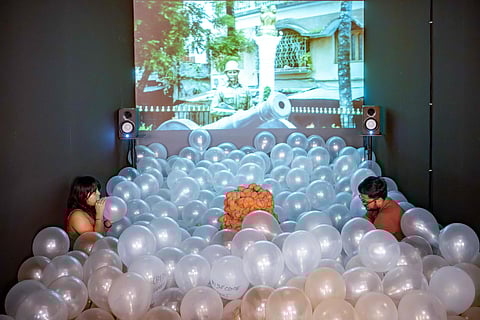
This year’s theme, For the time being, spans the poignant to the strange. With more than 60 artists across 22 venues until March 31, the biennale can feel overwhelming. If you are short on time but want to see the best of it, bookmark this list.
If you cannot explore all of Aspinwall House, begin at the Panjeri Artists’ Union corner. The collective of artists, academics, activists and students addresses how ordinary lives are reshaped by economic, social and political pressures.
Nearby is Dhiraj Rabha’s The Quiet Weight of Shadows, drawn from his own experience of militancy in Assam, reflecting on resistance, surveillance and displacement. Across the courtyard, Bhasha Chakrabarti’s textile installation Diasporic Transcriptions evokes women’s work and the sisterhood that forms around unpaid labour, shared chores and domestic routines.
At Anand Warehouse on Bazar Road, old wooden chairs from public institutions across Kerala, restored by local carpenters, fill the space in a half-elliptical arrangement reminiscent of a durbar. The walls are papered with discarded sacks stitched together by women from Kochi.
Ghanaian artist Ibrahim Mahama’s Parliament of Ghosts comments on conversations among those in power while the concerns of people who labour and trade outside state institutions are ignored. It is critical, yet unexpectedly joyful, and part of a wider international series.
Across the road, under Edam, which showcases art from Kerala, are Tom Vattakuzhy’s striking magazine illustrations created over decades for Malayalam short story writers. Edam continues at Cube Art Space further down Bazar Road with a show examining the many interpretations of the final moments of Gandhiji’s life. A short distance away in Jew Town, Monsoon Collective’s The Emperor’s New Clothes explores how clothing has shaped identity and history in Kerala.
Entering Ginger House through a cavernous antique store filled with Theyyam figures and winged creatures sets a mood that sharply contrasts with Shilpa Gupta’s Listening Air (2019–23). Her first installation, Sound on My Skin, resembles an airport departure board, flipping through fragmented phrases that slowly reveal a political statement on law, obedience and the pressures that force people to “cancel your protest… for your own safety”.
The centrepiece, Listening Air, is deeply affecting. Protest songs from around the world—Bella Ciao, Hum Dekhenge, No nos moverán—play in a darkened room with microphones, speakers and stools arranged in a circle. The initial unease of entering the space gives way to a sense of solidarity and fragile hope. It is emotionally demanding, making a restorative lime water at the sea-facing Museum Hotel café next door a welcome pause before moving on.
Opposite the Water Metro station on Willingdon Island, this 20,000 sq. ft venue houses large-scale works by LaToya Ruby Frazier, Marina Abramović and Arti Kadam, urging viewers to slow down and pay attention.
The most compelling is Mme, Mmu, Bhumi, Bhumi by South African artist Dineo Seshee Bopape. Anthill-like forms made from dung—sacred in her culture—echo the large anthills worshipped in parts of India, quietly underscoring shared traditions in an increasingly fractured world. The Palakkad-based Lakshmi Nivas Collective’s work, rooted in nature and restoration, rewards lingering.
If a sense of fracture and decay runs through much of the biennale, Of Worlds Within Worlds, Gulammohammed Sheikh’s major retrospective at Durbar Hall, Ernakulam, offers a rare moment of clarity and calm. Curated by the Kiran Nadar Museum of Art, the exhibition brings together decades of work by the 87-year-old master.
Dense with history, politics, literature and surreal imagination, Sheikh’s paintings demand close attention. Yet despite their severity, one leaves soothed, carrying the quiet belief that resistance—however fragile—remains possible.
(Article by Shalini Umachandran; by arrangement with livemint.com)

