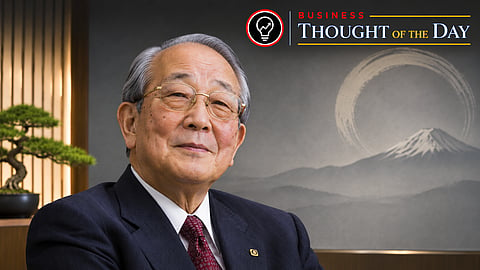

Imagine taking charge of a bankrupt airline at 78, with absolutely no experience in aviation, and refusing to accept a salary. Then imagine helping turn that airline into a profitable business within two years.
That is precisely what Japanese entrepreneur Kazuo Inamori did.
Known for founding technology giant Kyocera and helping establish telecommunications major KDDI, Inamori was already a celebrated businessman when Japan's government approached him in 2010 to rescue Japan Airlines (JAL).
His response was surprising. He initially refused because he knew nothing about running an airline. Eventually, he accepted the challenge, demonstrating that leadership sometimes depends more on understanding people than mastering a particular industry.
Born in Kagoshima, Japan in 1932, Inamori graduated in engineering from Kagoshima University. He began his career at a ceramics manufacturer before establishing Kyoto Ceramic Company in 1959, aged just 27, with capital of three million yen provided by acquaintances.
The company eventually became Kyocera, a global manufacturer of electronic components and advanced materials.
In 1984, he ventured into telecommunications by establishing Daini Denden, which later became part of KDDI, challenging Japan's established telecom industry.
Building successful businesses in two different industries established his reputation as one of Japan's most influential entrepreneurs.
One of Kazuo Inamori's most influential innovations was Amoeba Management, a system that divides large organisations into small, independently managed units. Each team tracks its revenue, expenses and productivity, encouraging employees to think like entrepreneurs rather than simply follow instructions.
The philosophy faced its biggest test in 2010, when Inamori, aged 78 and with no aviation experience, took charge of bankrupt Japan Airlines (JAL). He introduced greater financial accountability, empowered smaller operational units and encouraged employees to take ownership of the airline's recovery. Combined with extensive financial restructuring, cost reductions and government-backed assistance, these changes helped JAL return to profitability and relist on the Tokyo Stock Exchange in September 2012.
Inamori's experience showed how decentralised decision-making, financial discipline and employee involvement could help revive a struggling organisation. For Gen Z professionals, the lesson is particularly relevant: leadership begins with taking responsibility, not acquiring a designation. The same approach can help startups, digital agencies and growing businesses expand without losing control over costs and performance.
After employee training sessions, Inamori sometimes brought six cans of beer to employees or visited those working late. Over informal conversations, employees began sharing opinions they were reluctant to express in formal meetings.
The practice reflected Japan's tradition of nommunication, or building relationships through informal conversations over drinks. Inamori later explained the approach in a 2012 BBC interview. The lesson remains relevant to modern workplaces: employees are more likely to contribute ideas when leaders create an environment where people feel comfortable speaking openly.
By September 2012, JAL had returned to the Tokyo Stock Exchange. Its recovery was supported by substantial financial restructuring, public assistance, job cuts and operational changes, alongside Inamori's efforts to rebuild its corporate culture.
Unlike leaders who focused primarily on quarterly earnings, Inamori believed that businesses should pursue both employee wellbeing and profitability.
His philosophy centred on creating an organisation where employees could take pride in their work. This did not mean ignoring financial discipline. Inamori consistently advocated increasing revenue, controlling unnecessary expenses and making decisions based on sound ethical principles.
His leadership combined compassion with demanding performance expectations. The philosophy is especially relevant today, when younger professionals increasingly expect meaningful work, transparency and opportunities for growth.
However, his approach also raises an important question: how can companies encourage commitment without allowing a culture of hard work to become excessive pressure?
For modern managers, the challenge is balancing Inamori's emphasis on dedication with healthy workplace boundaries.
Three ideas from Inamori's career deserve particular attention.
First, industry experience is valuable, but the ability to learn, listen and organise people can be equally important. His JAL experience demonstrated this.
Second, employees become stronger contributors when they understand business economics. Whether working in a startup, media organisation or technology company, knowing how revenue, costs and customer satisfaction interact improves decision-making.
Third, leadership is ultimately tested during difficult situations. Founding a successful company is an achievement, but rebuilding a failing organisation demands a different level of responsibility.
Beyond business, Inamori established the Inamori Foundation in 1984 and created the Kyoto Prize to recognise contributions to science, technology, arts and philosophy. He also mentored entrepreneurs through his Seiwajyuku management school.
Inamori died on August 24, 2022, aged 90.
His legacy offers a reminder for aspiring entrepreneurs and Gen Z professionals: business success requires financial intelligence, personal integrity and the willingness to take responsibility.
And sometimes, a meaningful conversation over a few cans of beer can reveal problems that even the most sophisticated management dashboard cannot.
