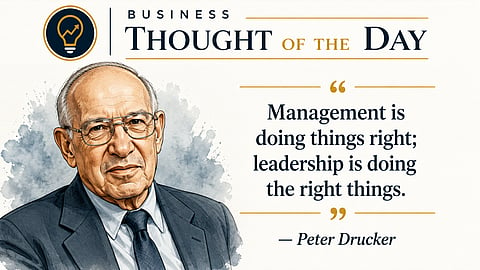

Every organisation values efficiency. Businesses invest heavily in technology, processes and training to ensure work is completed faster, better and at lower cost. But Peter Drucker's observation reminds us that efficiency alone cannot guarantee success. Before asking whether a task is being done well, managers must first ask whether it is the right task to pursue.
This distinction between management and leadership has become even more relevant in an era of rapid technological change, shifting customer preferences and intense global competition. A company can execute its plans perfectly and still fail if those plans are based on the wrong assumptions. Likewise, a leader who identifies the right opportunities can create enormous value even if execution requires constant refinement along the way.
Managers are responsible for organising resources, improving productivity and ensuring that day-to-day operations run smoothly. These responsibilities are vital because every successful business depends on disciplined execution.
Leadership, however, demands a broader perspective. Leaders decide where the organisation should go, which opportunities deserve investment and which risks are worth taking. They shape the vision that guides every operational decision.
Many companies have disappeared not because they lacked capable managers, but because they failed to recognise changing markets. They continued to improve products that customers no longer wanted or invested in technologies that were becoming obsolete. Their operations were efficient, but their strategic direction was flawed.
The lesson is clear: doing the wrong thing efficiently only accelerates failure.
Peter Drucker was born in Vienna, Austria, in 1909 and later moved to the United States, where he became one of the world's most influential management thinkers. During a career spanning more than six decades, he worked as a writer, professor and consultant, advising governments, multinational corporations and non-profit organisations. His practical approach to management helped transform it from an administrative function into a disciplined field of study.
Drucker authored nearly 40 books, many of which became essential reading for business leaders. His landmark works, including The Practice of Management, Management: Tasks, Responsibilities, Practices and Innovation and Entrepreneurship, introduced ideas that are now considered fundamental, such as management by objectives, decentralised decision-making, customer-centric business strategy and the importance of knowledge workers. His influence extended far beyond corporate boardrooms, shaping leadership practices in education, healthcare, government and the voluntary sector. Executives around the world continue to rely on his principles to build resilient, innovative and customer-focused organisations.
Drucker believed that the first responsibility of a leader is not to provide all the answers but to ask the right questions.
Managers should regularly examine whether their organisation's goals remain relevant. Are customers' needs changing? Is the business solving real problems? Are employees spending time on activities that genuinely create value?
Such questions often reveal opportunities that routine management may overlook.
Effective leaders also encourage innovation by challenging established practices. They understand that past success does not guarantee future growth and that every organisation must continuously adapt to remain competitive.
Successful organisations need both strong management and inspiring leadership. One cannot replace the other.
A visionary strategy without disciplined execution remains only an idea. Equally, perfect execution without a meaningful purpose leads to wasted effort.
The most respected business leaders combine both qualities. They define a clear direction while building systems that help their teams achieve measurable results. They empower employees, encourage accountability and remain willing to change course when circumstances demand.
For managers aspiring to senior leadership, Drucker's insight offers a valuable reminder. Career growth is not determined solely by operational excellence but also by the ability to think strategically and anticipate the future.
Peter Drucker's famous distinction between management and leadership is not meant to diminish either role. Instead, it highlights the importance of balance.
Businesses need managers who can improve processes, reduce costs and deliver consistent performance. They also need leaders who can see beyond today's challenges, identify tomorrow's opportunities and inspire others to pursue them.
The best organisations are those where people do the right things—and then do those things exceptionally well. That combination remains one of the strongest foundations for lasting business success.

