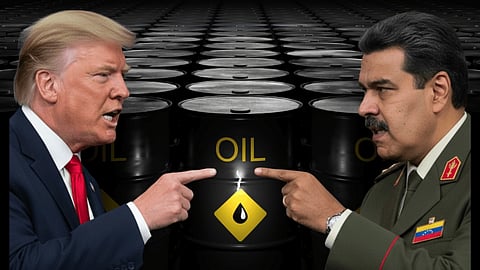

India’s renewed oil trade with Venezuela has come under sharp focus after the United States carried out military raids on the South American nation, raising fresh geopolitical risks in the global energy market.
While crude prices have so far remained subdued—hovering around the $60 a barrel mark—the developments are closely tracked in New Delhi, given India’s sharp rise in Venezuelan oil imports over the past year.
Venezuela, home to one of the world’s largest proven oil reserves, has gradually re-emerged as a key supplier for India after years of near-zero trade due to US sanctions. Any disruption to Venezuelan exports could affect India’s crude sourcing strategy at a time when refiners are actively diversifying supplies to manage price volatility.
While China remains the largest buyer of Venezuelan crude, India’s growing exposure is significant. India’s oil imports from Venezuela had dropped to negligible levels in 2021 and 2022, with total imports valued at just $89 million and $250 million in FY22 and FY23, respectively.
The trade rebounded sharply in FY24, with petroleum imports nearing $1 billion. In December 2023, India briefly emerged as the top buyer of Venezuelan oil. Data from the Directorate General of Commercial Intelligence and Statistics and the UN Comtrade database shows India’s imports rose to around 63,000–100,000 barrels per day in 2024—a jump of nearly 500 percent from the previous year.
India remained the third-largest buyer of Venezuelan oil for much of 2025, after China and the US, although imports began tapering towards the end of the year amid renewed sanctions and rising geopolitical tensions.
Venezuelan state-run energy company PDVSA’s oil production and refining activities were unaffected by the US attacks, with no damage reported at its most critical energy infrastructure. However, the port of La Guaira near Caracas—one of the country’s largest ports, though not directly used for oil exports—suffered severe damage.
In December, Donald Trump announced a blockade of oil tankers entering or leaving Venezuela, and US authorities seized two cargoes of Venezuelan crude. These measures prompted several vessel owners to divert away from Venezuelan waters, leading to a rapid build-up of crude and fuel inventories at PDVSA. The company has since slowed port deliveries and stored oil on tankers to avoid deeper production or refining cuts.

