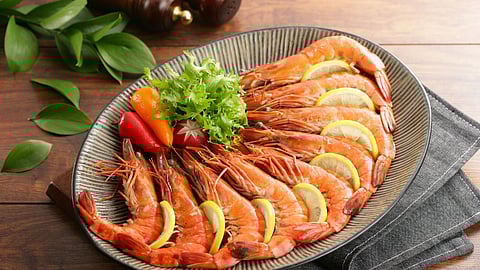

Seafood exporters are cautiously optimistic that business conditions will improve after the US sharply lowered tariffs on Indian exports, reversing a policy shock that had paralysed the shrimp industry for months. The reduction of US import duties on Indian goods to 18 percent from the punitive 50 percent imposed in August 2025 is being seen as a turning point for a sector that had nearly come to a halt.
The US is India’s largest seafood export market, with frozen Vannamei shrimp forming the bulk of shipments. The steep tariff hike last year wiped out India’s competitiveness overnight, allowing rivals such as Ecuador, Indonesia and Vietnam to capture market share. Exporters report that order pipelines dried up after October 2025, with little visibility on new contracts for early 2026.
Andhra Pradesh bore the brunt of the disruption. The state accounts for nearly 80 percent of India’s shrimp exports, and close to 70 percent of its shipments are destined for the US. In 2024–25, shrimp exports from Andhra Pradesh exceeded 3.6 lakh metric tonnes, valued at over ₹21,000 crore. The tariff shock affected the entire value chain, from hatcheries and feed suppliers to processors and exporters.
Industry participants say the tariff rollback restores India’s price competitiveness almost immediately. Enquiries from US buyers have begun to pick up, and exporters expect contract negotiations, usually finalised in January, to restart after being lost earlier this year to lower-tariff competitors.
In 2024-25 (FY25), India’s total seafood exports stood at $7.4 billion (₹61,400 crore), with the US accounting for 38 percent, or $2.78 billion (₹23,100 crore). During April–November of FY26, overall seafood exports declined 6.3 percent year-on-year, a fall widely attributed to the steep US tariffs.
Despite the setback in the US, marine product exports rose more than 15 percent year-on-year to $6.56 billion (₹54,400 crore) during April–December FY26, supported by a strong push into alternative markets such as Vietnam and Belgium. Exporters acknowledge, however, that diversification can only partially offset the loss of the US, given the scale and pricing advantages of that market.
Ecuador currently commands around 19 percent of the US seafood import market, valued at roughly $6 billion (₹49,800 crore). India is expected to regain some lost ground following the tariff cut, though industry players note that the pace of recovery will depend on how quickly contracts are renegotiated.
Looking beyond the US, exporters are also pinning hopes on Europe. The proposed India–EU trade agreement, which could remove duties ranging from 4.2 percent to 7.5 percent, is seen as a potential catalyst for expanding access to the European marine products market, estimated at $53.6 billion (₹4.45 lakh crore) annually. Marine exports to the EU, currently valued at about $1 billion (₹8,300 crore), are expected to rise sharply over the next few years if the agreement is finalised.

