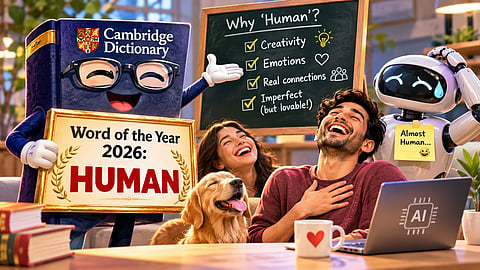

Cambridge Dictionary has named ‘human’ its Word of the Year for 2026, reflecting a growing global debate about the role of artificial intelligence (AI) and what distinguishes people from machines.
Announced on November 18, the choice comes as AI-generated writing, images, music and other digital content become increasingly difficult to distinguish from human creations. According to Cambridge Dictionary, the word captures a renewed appreciation of human qualities at a time when technology is transforming how people work, communicate and create.
Cambridge Dictionary defines the adjective ‘human’ as having the qualities, faults and feelings associated with people, distinguishing them from gods, animals and machines.
Although the word has existed for centuries, its usage is evolving. Expressions such as ‘human-written’, ‘human-generated’ and ‘human-made’ are becoming more relevant as people seek to identify content and products created without artificial intelligence.
The dictionary suggests that this linguistic shift may indicate something more significant than changing vocabulary. It could reflect a broader reassessment of humanity’s relationship with increasingly sophisticated machines.
The rapid adoption of AI has created a new challenge for businesses and consumers: determining the value of human involvement when machines can produce similar results.
This has contributed to discussions around the ‘human premium’, the additional value people may attach to products, services and experiences involving genuine human effort.
In creative industries, for instance, original artwork, writing and music made by people could attract greater appreciation as AI-generated alternatives become more widespread.
The same debate extends to education, customer service, entertainment and professional services, where businesses must decide how to balance automation with human judgement and interaction.
Colin McIntosh, chief editor of Cambridge Dictionary, said AI's growing presence across society had prompted people to reconsider what being human means. The dictionary's analysis of language data, online trends and search habits helped shape its decision.
Advances in AI have further complicated the distinction between human and machine behaviour.
A University of California, San Diego study reported that participants identified GPT-4.5 as human in 73% of certain 15-minute text conversations. The findings highlighted how convincingly AI systems can imitate human interaction, although such performance does not establish consciousness or genuine human understanding.
The developments have intensified questions about creativity, trust and authenticity, particularly as organisations increasingly integrate AI into everyday operations.
Four other words were shortlisted for Cambridge Dictionary's 2026 selection: ‘analogue’, ‘agent’, ‘wholesome’ and ‘chic’.
Of these, ‘agent’ has particular relevance to technology, referring to AI systems capable of performing complex tasks and making decisions with limited human intervention.
‘Analogue’, meanwhile, reflects interest in experiences that do not depend on digital technology.
Cambridge Dictionary's choice illustrates an emerging paradox. As machines become more capable of reproducing human activities, the qualities associated with being human may become more valuable.
The word is familiar, but its significance has changed in the age of AI.
