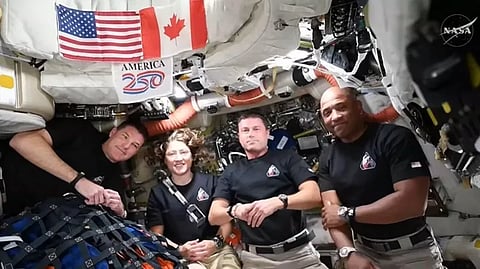

Humanity moved a decisive step closer to returning to the Moon as Nasa's Artemis II astronauts splashed down safely on Earth after a historic nine-day journey. It marked the first crewed mission to the lunar vicinity in more than half a century and signalling the start of a new era in deep-space exploration.
The crew safely returned to Earth after a “textbook” splashdown in the Pacific Ocean, bringing to a close a landmark journey that signals a new phase in human space exploration.
Commander Reid Wiseman and his three crewmates confirmed they were “feeling great” after re-entry, which included a tense six-minute communications blackout as their Orion spacecraft plunged through Earth’s atmosphere at high speed. Recovery teams quickly secured the capsule and airlifted the astronauts to a US Navy ship for medical checks.
During the nine-day mission, the spacecraft travelled over 6,94,000 miles, including a close lunar flyby.
On April 6, the crew reached a maximum distance of about 4,06,771 km from Earth, setting a new record for the farthest humans have ever travelled in space—surpassing the previous mark set during the Apollo 13 mission.
The mission also marked several historic firsts: the first woman, the first person of colour, and the first non-American to travel into deep space beyond Earth orbit.
Artemis II is the first crewed mission under Nasa's Artemis programme, a long-term effort to return humans to the Moon and eventually establish a sustained presence there. The programme is widely seen as the successor to the Apollo era, which ended in 1972.
Unlike the Apollo missions that landed astronauts on the lunar surface, Artemis II was a test flight. Its main goal was to validate critical systems—especially the Orion spacecraft, life-support systems, and the Space Launch System rocket—for deep-space travel with humans onboard.
The mission followed a “free-return trajectory”, looping around the Moon and using its gravity to bring the spacecraft back to Earth without requiring major propulsion changes—an approach designed for safety.
Nasa officials described the successful return as the beginning of a “new era of human space exploration”. The mission tested technologies that will be crucial for future lunar landings, including heat shields capable of withstanding extreme re-entry temperatures and life-support systems for deep-space missions.
The next major step, Artemis III, aims to land astronauts on the Moon—potentially by 2028—and could include building a long-term human presence near the lunar south pole.
Following splashdown, the astronauts will undergo routine medical evaluations before being transported to Nasa's Johnson Space Center in Houston for debriefing and analysis.
Scientists will now study data collected during the mission, including observations of the Moon’s far side and system performance in deep space. The findings are expected to shape future missions—not just to the Moon, but eventually to Mars.
With Artemis II completed successfully, humanity has taken its most significant step in decades towards returning to the lunar surface—and staying there.

