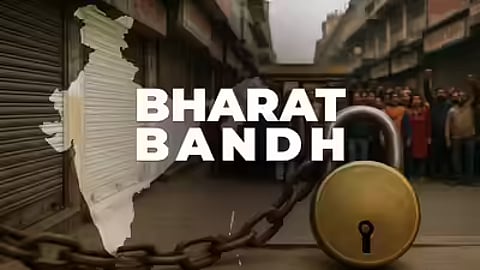

A nationwide general strike, or Bharat Bandh, is being observed today (February 12) following a call by a joint forum of 10 central trade unions. Several farmers’ organisations have extended support to the protest.
The strike has been called to oppose the four new labour Codes and to protest against the recently announced India-US trade deal. While the day has not been declared a public holiday, banking and transport services may face partial disruptions in several states.
The protesting unions argue that the four labour Codes — which replaced 29 existing labour laws — dilute worker protections and provide employers greater flexibility in hiring and retrenchment.
Key concerns raised by unions include:
Weakening of labour rights under the new Codes
Privatisation of public sector undertakings
Slow wage growth
Issues related to social security benefits
Major unions participating in the strike include CITU, AITUC, INTUC, HMS, AICCTU, LPF and UTUC.
In addition, unions are demanding:
Withdrawal of the Draft Seed Bill
Rollback of the Electricity Amendment Bill
Scrapping of the SHANTI Act
Restoration of MGNREGA
Repeal of the Viksit Bharat – Guarantee for Rozgar and Ajeevika Mission (Gramin) Act, 2025
Farmers’ bodies such as the Samyukt Kisan Morcha (SKM) and the All-India Kisan Sabha (AIKS) have backed the bandh, expressing concern over the impact of the proposed India-US interim trade agreement on domestic agriculture.
SKM convenor Hannan Mollah said the agreement would harm Indian farmers and accused the Centre of compromising national interests in negotiations with the US. The farmers’ groups had conducted a campaign between February 4 and 11 leading up to today’s strike.
Banking
Public sector bank services may be impacted as employee and officers’ unions, including AIBEA, AIBOA and BEFI, have joined the strike.
The State Bank of India has said services may be partially disrupted. However, February 12 has not been declared a bank holiday by banks or the Reserve Bank of India. Branches are expected to remain open, though customers may face delays in certain services.
Transport and markets
Road blockades and protest marches could disrupt bus and taxi services in some states
Local markets and shops may remain closed in select areas
Government offices may see reduced attendance
Hospitals and emergency services
Ambulance services
Airports
Essential utilities
While the extent of disruption will vary by state, essential services are expected to function normally, with the main impact likely to be on banking and local transport operations.

