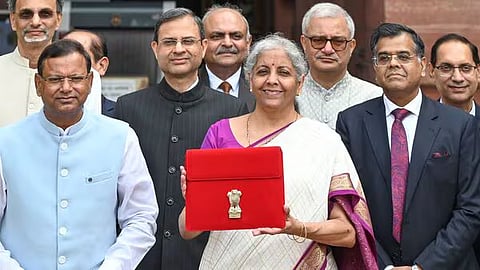

In a rare departure from the conventional parliamentary schedule, Union finance minister Nirmala Sitharaman is set to present the Budget on Sunday, February 1, underscoring the government's commitment to maintaining the fiscal timeline regardless of the calendar day.
This year’s Budget carries profound significance as it serves as the definitive roadmap for 'Viksit Bharat.' Beyond a mere statement of accounts, the presentation acts as a pivotal policy anchor, balancing the urgent need for middle-class tax relief and rural economic stimulus with the long-term imperatives of fiscal consolidation and massive infrastructure investment in a volatile global economic landscape.
As the countdown to the Budget begins, the North Block of the Central Secretariat transforms into a high-security fortress. While the public focuses on tax slabs and fiscal deficits, the process leading up to the finance minister’s speech is a masterclass in secrecy.
Interestingly, the Indian Constitution does not use the word ‘Budget’. Under Article 112, it is referred to as the Annual Financial Statement (AFS). The protocol dictates that the President of India must cause the budget to be laid before both Houses of Parliament. While the finance minister delivers the speech, they do so as a representative of the executive, fulfilling this constitutional obligation to the legislature.
The preparation begins as early as August or September, nearly six months before the presentation date.
The circular: The Ministry of Finance issues a ‘Budget Circular’ to all ministries and states, seeking expenditure estimates.
The consultations: The fnance minister holds ‘pre-cudget consultations’ with economists, trade unions, and industry leaders to gauge the nation's pulse.
The Blue Sheet: This is the most guarded document. It contains the secret summary of the entire budget, serving as the master document from which all other figures are derived.
The Union Budget is perhaps the only government document where secrecy is a matter of national security.
The halwa ceremony: About 10 days before the budget, this ceremony marks the commencement of the printing process. Once sweets are served, over 100 officials are ‘locked in’ the basement of North Block.
Isolation: These officials remain cut off from the outside world—no mobile phones or internet—until the Finance Minister begins the speech in Parliament to prevent market-sensitive leaks.
On the day of the budget, a precise sequence of events unfolds:
The President’s assent: The finance minister visits Rashtrapati Bhavan to seek formal approval.
Cabinet briefing: The FM heads to Parliament to brief the Cabinet on the highlights.
The Budget speech (11:00 am): The speech is divided into Part A (economic survey and policy reforms) and Part B (tax proposals).
The tabling: Following the speech, the document is tabled in the Rajya Sabha.
The presentation has seen significant shifts in recent years:
The date: In 2017, the date was moved from the last day of February to February 1 to ensure the legislative process concludes before the new financial year begins.
The merger of railway budget: The 92-year-old tradition of a separate Railway Budget was scrapped in 2017, merging it with the Union Budget.
The ‘bahi-khata’ & tablet: In 2019, the briefcase was replaced by a traditional ‘bahi-khata’. By 2021, the budget went fully digital, marking the ‘Paperless Budget’ era.
The Finance Minister faces the daunting task of sticking to the fiscal deficit glide path while ensuring the economy doesn't overheat. A lower deficit target could strengthen the Rupee, whereas high-spending measures might stir inflationary concerns.
The Union Budget is more than just a speech; it is a signal of the government's priorities. The meticulous procedures ensure that despite political pressures, the fiscal integrity of the nation remains intact. As the FM prepares to unzip the digital briefcase this Sunday, all eyes will be on whether the ‘Blue Sheet’ secrets translate into a ‘geen signal’ for the Indian economy.
