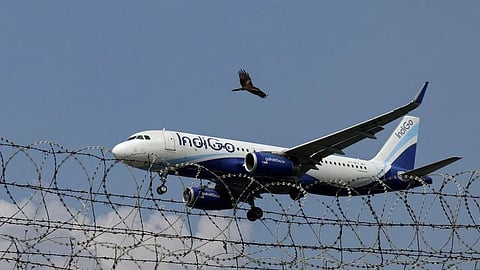

The Competition Commission of India (CCI) has ordered a detailed investigation into IndiGo, alleging abuse of its dominant position in the domestic aviation market following large-scale flight cancellations in December 2025.
The regulator has directed its investigation arm, the Director General (DG), to examine potential violations of the Competition Act, which relate to unfair conditions and restriction of services. The DG has been asked to submit its findings within 90 days.
In its order, the CCI noted that IndiGo’s cancellation of thousands of flights during a peak travel period effectively reduced the availability of air services in the market. This, the regulator observed, led to artificial scarcity, sharply higher airfares and severe inconvenience to passengers.
Data cited by the CCI showed that IndiGo cancelled 2,507 flights and delayed 1,852 flights in December 2025, impacting more than three lakh passengers across multiple airports. With limited alternative options available, many travellers were left stranded, while fares across several routes rose sharply after the cancellations.
The CCI flagged IndiGo’s dominant position in the domestic aviation sector, pointing to its sustained market share of around 60–61 percent in terms of available seat kilometres (ASKM). This, the regulator said, reflects not only high passenger volumes but also significant control over capacity and supply-side conditions in the market.
According to the order, the domestic aviation market in India has become increasingly concentrated, limiting the ability of competitors to exert effective competitive pressure. Such concentration, the CCI observed, raises concerns that leading airlines may be able to operate independently of market forces.
In its defence, IndiGo argued that issues related to flight operations and airfare fixation fall under the exclusive jurisdiction of the Directorate General of Civil Aviation (DGCA), as governed by the Bharatiya Vayuyan Adhiniyam, 2024, and the Aircraft Rules, 1937. The airline maintained that airfares are subject to continuous regulatory oversight by the Ministry of Civil Aviation and the DGCA, including fare ceilings imposed in the public interest.
However, the CCI rejected this argument, reiterating that sectoral regulation does not exempt airlines from the application of competition law. The commission noted that it has previously examined aviation-related cases involving cartelisation, abuse of dominance and unfair pricing practices, and that competition law and sectoral regulation operate in complementary domains.
The outcome of the DG’s investigation could have wider implications for pricing practices, capacity management and competition in India’s increasingly concentrated aviation market.

