
₹30,000 crore. That is the estimated size of India’s sanitaryware and faucet market. Competition in this market is exceptionally intense.
However large a brand may be, it can fall behind if it fails to keep pace with changing consumer preferences and technology. This is where Cera Sanitaryware, which has been present in the Indian market since 1980, stands apart.
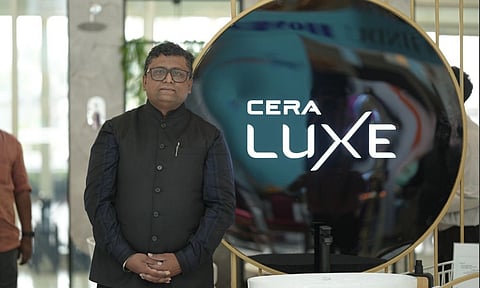
Cera recorded a turnover of ₹2,050 crore in the last financial year. Steering its growth journey is Sandeep Abraham, the company’s President, Sales & Growth Strategy.
Though a Malayali, Sandeep was born and brought up in Jabalpur, Madhya Pradesh. Visits to Kerala during his childhood summer holidays strengthened his connection with the state.
Sandeep, who has studied at the Indian Institute of Management Nagpur, has 32 years of experience in sales and marketing in the building materials industry. The different roles he has held during his career, including responsibility for Parryware’s South Indian market, have helped him understand the diverse markets across the country.
At Cera, he is a senior management leader involved not only in sales but also in profit and loss management, finance, product, marketing and talent management.
In this interview with Dhanam, Sandeep shares several business lessons that could guide entrepreneurs and professionals.
What has driven the transformation at Cera over the past few years?
I see the market as a battlefield. Strategies can be formulated in the boardroom, but the real victory is won in the market.
When I joined Cera in 2023, the company’s growth had slowed slightly. For a business to grow, it must increase its number of customers.
I divided Cera’s markets into two categories: core markets and focus markets. Strong markets such as Kerala were classified as core markets, while weaker ones were treated as focus markets.
We did not apply the same strategy in every state. We made targeted interventions in Madhya Pradesh, Bihar, West Bengal, the Northeast, Jharkhand and Chhattisgarh.
These efforts delivered results in several markets. Some of them grew by as much as 40% to 50%.
Does that mean a ‘one India, one strategy’ approach will not work for a national brand?
Absolutely. Kerala and Jammu and Kashmir are not markets with the same characteristics.
Kerala is a distribution-led market. In some North Indian markets, a direct dealer model may work better. There are differences even within individual states.
Regional tastes are the first thing entrepreneurs seeking growth across India must understand.
The product, price, channel, business model and communication must all change according to the market. A strategy implemented uniformly across the country will fail.
Is Cera placing greater emphasis on the premium segment and project sales?
Cera is a popular brand embraced by Indian consumers and has substantial business volumes. At the same time, there are customers who seek premium products.
That is why we introduced a super-premium brand called Cera Luxe. These premium products are available in only 22 of the more than 2,000 outlets in Kerala.
This has helped us attract architects and large builders. Senator is our brand for customers looking for an even higher level of luxury.
Earlier, 70% of our business came from retail and 30% from projects. Through the new strategy, we increased the share of project sales to 40%.
Today, we have orders worth ₹1,500 crore in the project segment alone. This has helped us build business relationships with major brands such as Godrej.
We have also developed brand collaborations with McDonald’s, Urban Company and River EV Mobility. When younger consumers see Cera across these brands and locations, they begin to perceive it as a high-value brand.
I also concentrate on developing ‘hero products’. We identify gaps in the market and introduce products at the right price to fill those gaps.
Sanitaryware is a category that consumers have traditionally purchased after touching, examining and seeing the product for themselves. Despite several attempts, e-commerce has not been able to dominate this market.
Our distribution network is our strength.
How do you keep distributors closely associated with the company?
Of our approximately 1,800 distributors, the top 200 contribute 70% of the company’s turnover. They are members of our Allied Club.
We have appointed a dedicated team to address their requirements quickly. Even on their birthdays, greetings and gifts are sent directly from the company. They greatly appreciate such gestures.
The implementation of a distribution management system has also given both the company and its dealers accurate data on stock and sales.
We can now see the distributor’s inventory, secondary sales, which stock-keeping units are moving and where sales are declining.
Earlier, interventions were based largely on assumptions. Today, they can be driven by data.
Loyalty programme automation, field-call tracking and coverage tracking have also been introduced.
Everyday business should move into an automated mode. Business leaders should not spend their time managing routine matters.
When systems take care of everyday operations, the leadership should be thinking about the company’s growth in the following year.
The same practical approach is required when adopting artificial intelligence.
Artificial intelligence can assist with productivity, training and presentations. However, companies must be conscious of the risks involved in sharing critical business information.
A company should not rush into a technology simply because it has arrived. It must first examine whether the technology is secure and whether the investment will produce adequate returns. Adoption should then take place gradually.
Have you experienced strategies that failed? What did you learn from them?
Failures are always temporary.
Recently, when fuel prices increased, we suddenly introduced a surcharge on our products in April. However, dealers were unable to recover the additional amount from customers, and the strategy failed.
We learnt from the experience. In May, we took the bold decision to increase prices directly. It became a major success.
I even wrote a LinkedIn article about it titled ‘The three A’s of leadership in uncertainty’.
How do you manage Gen Z employees?
The important thing is to understand them and work with them.
They learn quickly and use digital technology effectively. When someone is doing the job properly, why should we object to that person wearing jeans to the office?
We must change with the times.
We also use new technologies, including artificial intelligence, to measure the efficiency of our employees.
How do you view the business opportunities in Kerala?
Vizhinjam Port will create a major leap for Kerala.
High-quality medical tourism and Ayurveda also have enormous potential. As the number of older people increases, there will also be significant opportunities for high-quality retirement homes in the state.
Every brand grows through trust. It takes at least 10 years to build a new brand successfully at the national level.
Consumer preferences differ from one state to another. Hindustan Unilever, for example, sells its products differently in different states.
Businesses must understand regional preferences and identify the right hero products.
Developing a clear business model, retaining the best dealers and team members, and maintaining financial discipline are among the most important requirements for success.
A business may sometimes have to sacrifice a small portion of its profits to capture a market. However, every such decision must be supported by a long-term business plan.
This is a translated version of the article published in the 31 July 2026 issue of Dhanam.
