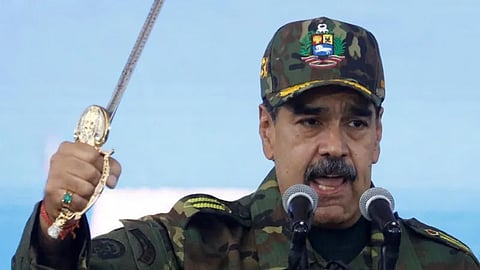

The US airstrikes on Caracas and the capture of Venezuelan president Nicolás Maduro mark one of the most dramatic escalations in Washington’s relationship with Latin America in decades. Never before has the US seized a sitting head of state and flown him out of his country to face trial.
The operation followed months of mounting military, economic and political pressure by the Trump administration, which has openly targeted Maduro since the start of Donald Trump’s second term. Overnight strikes hit key sites in Venezuela, including areas around the capital, before US forces detained Maduro and his wife, Cilia Flores. US officials say both will face trial in New York on narco-terrorism charges linked to a 2020 indictment.
Unprecedented action
This is the first time Washington has seized a sitting head of state.
Maduro and his wife, Cilia Flores, were flown out of Venezuela and are expected to face trial in New York on narco-terrorism charges linked to a 2020 indictment.
Long-running accusations
The US has accused Maduro of running a “narco-state” and protecting drug trafficking networks moving cocaine and fentanyl into the US.
Trump has repeatedly blamed Maduro for the surge of Venezuelan migrants at the US border, alleging — without evidence — that criminals were deliberately pushed out of the country.
Maduro has denied all allegations, calling them a cover for US-backed regime change.
Escalating military pressure
Since September, the US navy has built up a large force off Venezuela’s coast.
US forces have carried out more than 30 strikes on vessels accused of drug trafficking in the Caribbean and Pacific.
Human rights groups say over 110 people were killed in these maritime strikes, raising concerns about potential war crimes.
The US also seized Venezuelan oil tankers and enforced what amounted to a naval blockade.
Energy and oil interests
Venezuela holds the world’s largest proven oil reserves.
Trump has said the US will be “strongly involved” in Venezuela’s oil sector going forward.
Venezuelan officials argue the real aim of the military campaign is to gain control over oil resources rather than restore democracy.
Decades of strained relations
US-Venezuela ties have been tense since socialist leader Hugo Chávez took power in 1999.
Relations worsened after Maduro succeeded Chávez in 2013, amid accusations of authoritarianism, human rights abuses and erosion of democratic institutions.
In 2019, the US recognised opposition leader Juan Guaidó as Venezuela’s president.
After disputed elections in 2024, Washington backed opposition candidate Edmundo González.
What happens next
Maduro’s capture leaves Venezuela’s political future uncertain, even as the military leadership vows to resist foreign intervention.
The US has said it will play a central role in deciding Venezuela’s next steps.
Analysts warn that Maduro’s removal could trigger prolonged instability, power struggles and fresh refugee flows — scenarios previously predicted in US war-game simulations.

