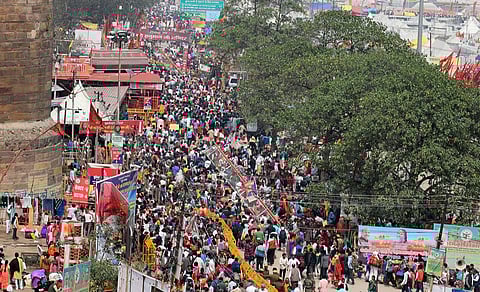

India has launched its long-delayed population census, the world’s largest administrative exercise, aimed at counting more than 1.4 billion people and capturing critical socio-economic data for policy and governance.
The 16th census since Independence—and the first in over 15 years—will be conducted in two phases over an extended period, involving more than three million enumerators and supervisors. The exercise covers all 36 states and Union Territories, spanning over 7,000 sub-districts, nearly 10,000 towns and about 6,40,000 villages.
At the core of the census is a 33-question schedule that gathers details on housing conditions, access to amenities, education, employment, migration and fertility. It also includes caste data, a politically sensitive addition that is expected to influence welfare policies and political representation.
The first phase, known as the House Listing and Housing Census, will collect information on households, including type of housing, assets and basic facilities. The second phase—population enumeration—is scheduled for February 2027 and will capture detailed demographic data.
The rollout has begun in selected regions such as Andaman and Nicobar Islands, Delhi, Goa, Karnataka, Mizoram and Odisha. In these areas, self-enumeration is being carried out between April 1 and 15, followed by field surveys until mid-May.
For the first time, the census will be conducted digitally, with officials using mobile applications to record and upload data. Authorities have also introduced a self-enumeration option through a multilingual online portal, allowing households to submit details and generate a unique ID for verification.
India last conducted a census in 2011, with the 2021 round delayed due to the pandemic and subsequent administrative constraints. The absence of updated population data has forced policymakers to rely on sample surveys, raising concerns over accuracy in welfare delivery and economic planning.
Experts say outdated classifications of rural and urban areas could distort public spending, as many regions have undergone rapid transformation over the past decade. Programmes tied to such classifications risk misidentifying beneficiaries, particularly migrant workers and informal sector households.
India’s census has evolved significantly from its early versions under colonial rule, expanding from basic population counts to detailed socio-economic profiling. Over time, it has incorporated data on employment, migration, literacy and living standards, reflecting changing policy priorities.
The latest round also reflects shifting social realities, with provisions to record non-traditional household structures, including live-in relationships treated as stable unions.
While the census remains a cornerstone of governance, concerns have emerged over data privacy and potential misuse, particularly amid parallel efforts to build population databases. Analysts warn that such concerns could influence responses, including over-reporting of household members.
Despite these challenges, the census is widely seen as essential for updating India’s socio-economic baseline. With nearly 70 percent of the population in the working-age bracket and a median age of 28, the data is expected to play a key role in shaping welfare schemes, infrastructure planning and economic strategy in the years ahead.

