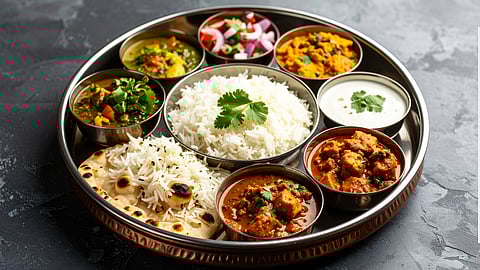

Indian households appear to have caught a small break on their monthly food bills. According to Crisil’s latest Roti Rice Rate index, the cost of preparing both vegetarian and non-vegetarian thalis dropped 13% in November compared with a year ago. For families constantly juggling rising expenses, this is one of the sharpest annual declines seen in thali costs in recent months and could feel like a welcome, if tentative, pause in kitchen cost pressures.
The index, tracked by Crisil every month, looks at the prices of key items that go into a basic home-cooked plate of food. In simple terms, it tries to capture what it actually costs to cook a standard meal at home, rather than just showing abstract inflation numbers. The latest reading suggests that, for now at least, softer prices of vegetables, pulses and chicken are filtering through to household budgets.
A big part of the relief seems to be coming from three familiar items that sit in almost every Indian kitchen: tomatoes, onions and potatoes. Crisil’s analysis shows that prices of all three corrected sharply in November compared with a year earlier.
Tomato prices fell 17% year-on-year, largely because more supplies reached markets. Potato prices dropped 29%, helped by what analysts describe as a “high base” last year, meaning that prices then were already quite elevated. Onions saw the steepest move, sliding 53% as heavy stocks from the previous rabi season and weak export demand prevented prices from flaring up.
Pulses also joined this cooling trend. Their prices are estimated to have fallen 17% after higher imports of Bengal gram, yellow peas and black gram in the last financial year boosted domestic availability. For a typical vegetarian plate, where dal is almost non-negotiable, this combination of cheaper vegetables and more affordable pulses likely made a visible difference to the monthly grocery bill.
The non-vegetarian thali did not stay behind. Its cost also fell 13% on-year and 1% month-on-month in November. The main reason appears to be chicken. Broiler prices fell around 12% as oversupply hit the market. Since chicken usually accounts for nearly half the cost of a non-vegetarian thali, any meaningful dip here can quickly show up on the final plate cost.
Lower prices of vegetables and pulses added to this softness in the non-veg plate. However, the fall was not entirely free of friction. Vegetable oil prices climbed around 6% during the festival season, and domestic LPG cylinder prices also moved up by about the same margin. Both these components sit in the “invisible” part of food spending – they do not appear on the plate but are essential to cooking it – and may have muted some of the gains from cheaper raw ingredients.
The story changes slightly when the focus shifts from year-on-year to month-on-month trends. On a sequential basis, the cost of a vegetarian thali actually rose 2% in November. After earlier declines, potato prices hardened by about 5% and tomato prices jumped 14% compared with October. For households, this means that while the plate is cheaper than it was a year ago, the last few weeks may not have felt like an uninterrupted slide in costs.
The non-vegetarian thali, by contrast, saw a 1% decline month-on-month. This is mainly because broiler prices are estimated to have fallen another 5% amid continued oversupply. Taken together, the numbers point to a market that is still quite choppy beneath the surface, even if the headline annual change suggests some easing.
This easing in thali costs comes against the backdrop of a tricky year for food inflation. Prices of essentials have swung around due to erratic weather, uneven supply cycles and changing export rules. Policymakers and the Reserve Bank of India are watching food prices closely because they play an outsized role in retail inflation and directly affect household sentiment.
According to official data, India’s retail inflation cooled to 0.25% in October, down from 1.44% in September. It was the third time in four months that the consumer price index reading slipped below the lower end of the RBI’s 2–6% target band. Economists suggest that sustained softness in vegetables, pulses and other kitchen staples could help keep headline inflation in check, but they also caution that these trends can change quickly, especially when weather and global prices are involved.
Recent tomato price behaviour is a reminder of how volatile food items can be. Mint reported on November 27 that retail tomato prices had crossed ₹80 a kg in Delhi and in several other regions after cyclone-related disruptions hit key growing belts in Andhra Pradesh and Karnataka. To contain the surge, the consumer affairs ministry stepped in and began selling “Janata” brand tomatoes at ₹52 a kg through the National Cooperative Consumers’ Federation of India. Moves like this can offer short-term relief but may not fully shield consumers if supply shocks keep recurring.
Crisil Intelligence director Pushan Sharma points out that November’s comfort largely rests on specific supply conditions. Onion prices dropped because of abundant rabi stocks and subdued exports. Tomato arrivals improved at mandis, and potato prices corrected from last year’s high levels. Pulse prices softened after higher imports in the previous fiscal year increased domestic availability.
Looking ahead, the picture may not be equally smooth across all items. Over the medium term, onion prices are expected to firm up again as delayed kharif harvesting and lower yields start to show up in supply. Potato prices, on the other hand, may moderate further as cold-storage stocks are gradually released into the market. Pulses could stay in a range, shaped by two opposing forces: a 30% import duty on yellow peas, which may keep a floor under prices, and unrestricted imports of black gram, which may prevent them from shooting up too sharply.
Any fresh policy decision on import duties, especially if rates are raised or extended, could add upward pressure on certain pulse prices. For now, though, households seem to be catching a brief window where many core ingredients are not biting as hard into monthly budgets.
The latest Roti Rice Rate index reading suggests that, at least for November, the average cost of cooking a plate of food at home eased noticeably for both vegetarian and non-vegetarian households. For many families, this may translate into a little more breathing space in their monthly spending, even if it does not fully reverse the stress built up over earlier bouts of food inflation.
Whether this turns into a lasting trend remains to be seen. Weather, crop outcomes, global commodity prices and government policy decisions all have the potential to quickly change the direction of kitchen costs. For now, the data hints at some relief on the plate – but households and policymakers alike will probably keep watching the thali just as closely as the inflation charts.

