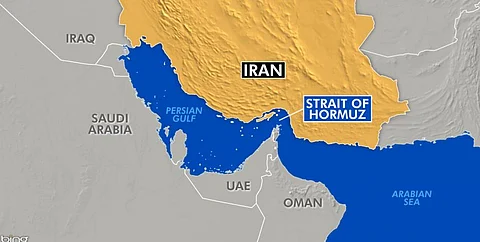

As tensions escalate across West Asia, Iran’s embassy in India has reassured Indian stakeholders on the safety of maritime movement through the Strait of Hormuz, triggering widespread attention on social media.
The Strait of Hormuz, a critical global energy corridor, handles roughly 20 percent of the world’s oil supplies and a significant share of India’s crude imports. It connects the oil-rich Persian Gulf to international markets and typically sees over 130 ships transit daily. However, amid the ongoing conflict, traffic has dropped sharply, with only three to four vessels managing passage each day.
In a series of posts, the Iranian embassy stated that the future of the Strait would be determined solely by Iran and Oman, adding that “Indian friends are in safe hands”. The messaging was widely interpreted as a reassurance to India amid concerns over supply disruptions.
While Iran has not formally closed the Strait, it has effectively introduced a selective blockade. Access has reportedly been restricted for the US, Israel and their allies, while vessels from countries considered “friendly”, including India, are being allowed to pass.
There are also indications that Iran may introduce a regulatory mechanism requiring ships to seek prior approval, and potentially pay transit fees, to move through the Strait.
Crude oil prices have surged close to $110 a barrel after US President Donald Trump signalled a more aggressive stance on Iran, without offering clarity on reopening the Strait. The spike follows a sharp 60 percent rise in oil prices in March.
Global markets reacted negatively to the escalation. S&P 500 futures fell 1.2 percent after recent gains, while European and Asian equities also declined.
OPEC ministers are set to meet on Sunday, but analysts expect limited intervention capacity. The ongoing conflict has already disrupted supply chains, with the International Energy Agency estimating a loss of around 12 million barrels per day — roughly 12 percent of global consumption.
While Saudi Arabia and the UAE have managed to reroute some exports, countries such as Iraq and Kuwait continue to face logistical constraints due to their dependence on the Strait.
The evolving situation in the Strait of Hormuz remains a key risk factor for global energy markets and India’s import outlook.

