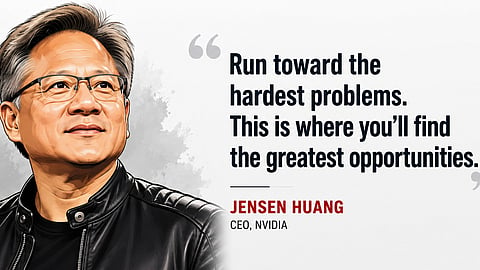

in a dramatic development on Monday, Nvidia has reinstated co-founder Jensen Huang as president and chief executive officer, less than two weeks after his sudden resignation, triggering a sharp rally in technology stocks across global markets. Shares of the US artificial intelligence (AI) chip giant surged nearly 30% in early Wall Street trading on Monday, as investors welcomed the return of the executive who transformed Nvidia into a dominant force in the global AI industry.
The company's board unanimously approved Huang's reinstatement following discussions about his ability to lead the business. Nvidia said the decision also followed consultations with senior US government officials, which gave the board confidence that his return posed no national security risk.
Huang stepped down on November 11 following revelations about alleged extramarital relationships, including one involving a woman suspected of links to Chinese intelligence. The controversy raised questions about potential national security implications, particularly given Nvidia's importance to advanced semiconductor technology and US-China competition.
Chief Financial Officer Colette Kress took over as interim CEO, while Harvey Jones became board chairman. Nvidia had initially indicated that Huang would not return, making Monday's announcement a significant reversal.
Huang's return immediately lifted investor sentiment following weeks of selling pressure on AI-related stocks.
The technology-heavy Nasdaq climbed nearly 6% in early trading, while the S&P 500 gained around 4%. European markets also advanced, with London's FTSE 100 rising approximately 1.1%, Germany's DAX gaining 1.9% and France's CAC 40 advancing 1.2%.
The rally highlighted Nvidia's enormous influence over global equity markets. Investors had become increasingly concerned about leadership uncertainty at the company, whose advanced chips power AI systems developed by major technology firms.
US President Donald Trump welcomed Huang's reinstatement, describing the decision as appropriate. The White House's involvement also underlined Nvidia's strategic importance to American technology leadership.
Despite the market recovery, Huang's return does not resolve broader questions surrounding the AI industry's valuations and investment prospects.
Technology companies are committing enormous sums to AI infrastructure, including data centres, advanced processors and computing systems. Goldman Sachs estimates that investment in AI could exceed $1 trillion in 2026.
However, uncertainty remains over whether these investments will generate sufficient returns to justify current valuations.
Investor concerns have also intensified following gains by Democrats in the US midterm elections, with several lawmakers advocating tighter regulation of AI companies.
For investors in India and other emerging markets, the developments underline how leadership changes and valuation concerns at major US technology companies can influence global risk appetite.
Huang's reinstatement may have restored immediate confidence in Nvidia, but questions surrounding corporate governance, regulatory scrutiny and the profitability of AI investments are likely to remain central to market sentiment.
