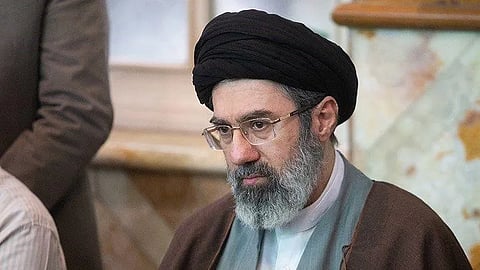

Mojtaba Khamenei, the son of slain Iranian leader Ali Khamenei, has been chosen as the new supreme leader of Iran following US-Israeli strikes that killed his father, marking a pivotal moment in the history of Iran.
The 56-year-old cleric has long been seen as an influential but shadowy figure within Iran’s power structure. Unlike his father, he has rarely appeared in public, has never held formal government office, and has given almost no interviews or speeches.
Israel’s defence minister has already warned that whoever succeeds Ali Khamenei would become a potential target — making the new leader one of the most closely watched figures in West Asian geopolitics.
Yet for more than two decades, political insiders and analysts have speculated that he wielded considerable influence behind the scenes in Tehran’s ruling establishment.
Born on September 8, 1969, in the northeastern Iranian city of Mashhad, Mojtaba is the second of six children of Ali Khamenei.
He received his early education at the Alavi religious school in Tehran. As a teenager, he served briefly in the military during the Iran‑Iraq War (1980–88), a conflict that deepened Iran’s hostility towards the US and Western powers.
In 1999, he moved to Qom, the country’s main centre of Shia religious scholarship, to pursue advanced theological studies. Interestingly, he only adopted clerical attire at this stage — relatively late compared with most Iranian seminarians.
Even today, Mojtaba is regarded as a mid-ranking cleric, which has raised questions about his religious credentials for the country’s highest post.
The Islamic Republic was founded after the Iranian Revolution, which overthrew the monarchy. Its governing ideology holds that the supreme leader should be selected based on religious authority and leadership ability — not hereditary succession.
That makes Mojtaba’s rise controversial for many Iranians, as it creates the perception of a father-to-son transfer of power.
Iran’s powerful Assembly of Experts — the clerical body responsible for choosing the supreme leader — formally selects the country’s top authority.
Although Ali Khamenei never publicly endorsed his son as successor, Mojtaba had long been viewed as a potential candidate.
In recent days, some Iranian media outlets and political figures have begun referring to him as “Ayatollah”, a senior clerical title. Observers see this as an effort to strengthen his religious credentials.
There is historical precedent: Ali Khamenei himself was elevated to the rank of Ayatollah soon after becoming supreme leader in 1989.
Mojtaba first came into the political spotlight during Iran’s 2005 presidential election, which brought hardliner Mahmoud Ahmadinejad to power.
Reformist candidate Mehdi Karroubi accused Mojtaba of influencing the vote through elements of the powerful Islamic Revolutionary Guard Corps and the Basij militia. The allegations were never officially proven but fuelled debate about his political role.
The issue resurfaced after Ahmadinejad’s disputed re-election in 2009, which triggered mass protests known as the Green Movement protests.
During those demonstrations, some protesters openly opposed the possibility of Mojtaba succeeding his father.
Two reformist leaders — Mir‑Hossein Mousavi and Mehdi Karroubi — were later placed under house arrest after challenging the election results.
As Iran’s new supreme leader, Mojtaba Khamenei is widely expected to continue the hardline policies associated with his father’s rule.
His personal circumstances may further harden his stance. Reports suggest he lost several close family members, including his father, mother and wife, in recent US-Israeli strikes. But the challenges ahead are formidable. Iran is grappling with severe economic pressure, international isolation and public discontent.
Mojtaba must now demonstrate leadership in a role where his political track record remains largely untested. At the same time, the perception that Iran’s leadership is becoming hereditary could deepen internal criticism of the regime.

