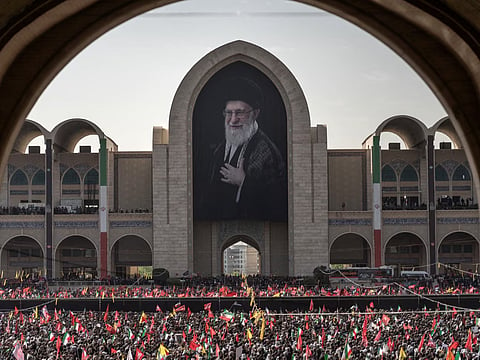

Iran has begun six days of elaborate state funeral ceremonies for former Supreme Leader Ayatollah Ali Khamenei, with millions of mourners are expected to gather in Tehran as the country seeks to project unity after months of war and political turmoil.
Public mourning started on Saturday at Tehran's Grand Mosalla mosque, where Khamenei's flag-draped casket, along with those of several family members killed in the same attack, was placed on display. Millions of people are expected to participate in funeral events across Iran before his burial later this week.
The funeral comes more than four months after Khamenei was killed during the opening phase of the US-Israeli conflict with Iran in late February. Iranian authorities postponed the ceremonies until after a ceasefire between Iran and the United States was reached last month, amid concerns that senior officials and large public gatherings could become targets for further attacks.
The funeral programme officially began with large crowds assembling from dawn at the Grand Mosalla mosque in Tehran. The coffin, draped in Iranian flags and enclosed in glass, were displayed on a raised platform as mourners paid their respects.
The state-organised ceremonies attracted millions of supporters, with many visibly emotional during the proceedings. Medical teams, ambulances and volunteers distributing drinking water were stationed across the venue as temperatures exceeded 32°C.
The Iranian government has scheduled funeral processions in several cities over six days. Following ceremonies in Tehran, Khamenei's remains will be taken to the holy city of Qom before travelling to the Iraqi shrine cities of Karbala and Najaf, both of great significance to Shia Muslims. He will finally be buried in his hometown of Mashhad on Thursday.
Following Khamenei's death, his son, Mojtaba Khamenei, was appointed as Iran's new Supreme Leader. He has not made a public appearance since assuming the country's highest political and religious office.
Foreign dignitaries, senior Iranian officials and representatives of Iran-backed groups from across the Middle East attended official condolence ceremonies ahead of the public funeral.
While the funeral has drawn large crowds of loyal supporters, it has also highlighted divisions within Iran. Many Iranians continue to criticise Khamenei's nearly four decades in power, citing political repression, economic hardship and corruption during his rule.
Some hard-line supporters also expressed dissatisfaction with the recent ceasefire with the United States, viewing it as a retreat rather than a victory. At the funeral, a section of mourners carried banners demanding retaliation for Khamenei's killing, while anti-US and anti-Israel slogans echoed through the gathering.
The funeral is being presented by Iranian authorities as a demonstration of the Islamic Republic's resilience following months of conflict and domestic unrest. The government hopes the large public turnout will reinforce its legitimacy after surviving a war that claimed several senior leaders and intensified political tensions inside the country.
The week-long ceremonies are expected to conclude with Khamenei's burial in Mashhad, marking the end of one of the most consequential chapters in Iran's modern political history and the formal beginning of a new era under its new Supreme Leader.

