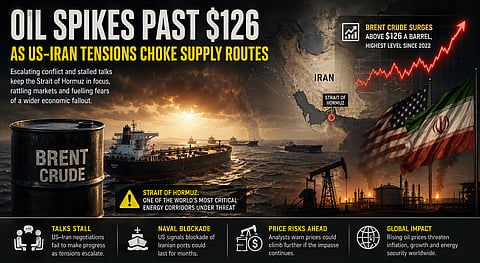

Global crude markets are on edge as geopolitical tensions in West Asia intensify, pushing benchmark prices sharply higher and raising fresh concerns over inflation and economic stability.
Brent crude surged above $126 a barrel on Wednesday, its highest level since 2022, after Donald Trump signalled that a US naval blockade of Iranian ports could be prolonged for months amid stalled diplomatic efforts.
Prices jumped more than 13 percent in just 24 hours, marking the sharpest spike since the conflict began in late February. The last time Brent crossed $120 was during the Russia's invasion of Ukraine, when crude briefly touched $139.
The escalation has effectively choked oil flows through the Strait of Hormuz, one of the world’s most critical energy corridors. Iran has responded to US pressure by restricting tanker movement, tightening global supply.
Market estimates suggest that disruptions in the strait could impact up to 20 million barrels of oil per day, significantly tightening availability and fuelling price volatility.
Efforts to revive negotiations have failed to gain traction, with planned US–Iran talks over the weekend not materialising. The prolonged standoff has heightened uncertainty across global energy markets.
Trump indicated that US authorities are prepared to sustain the blockade if necessary, aiming to force Iran to curb oil production by filling up its storage facilities, including key export hubs.
Analysts warn that the crisis could escalate further if the impasse drags on. Projections suggest oil prices could rise dramatically in the coming months under a prolonged disruption scenario.
Economist Paul Krugman cautioned that markets may be underestimating the risks, warning that a continued closure of Hormuz could trigger a global recession within months.
Historical parallels are also worrying. During the 2008 financial crisis, oil prices had surged to nearly $147 a barrel, underscoring how supply shocks can ripple across economies.
The surge in crude prices is already feeding into inflation concerns globally. Higher energy costs are expected to push up fuel prices, transportation costs and overall consumer inflation.
As the war enters its 10th week, what was initially expected to be a short conflict is evolving into a prolonged geopolitical and economic flashpoint, with significant implications for global markets.

