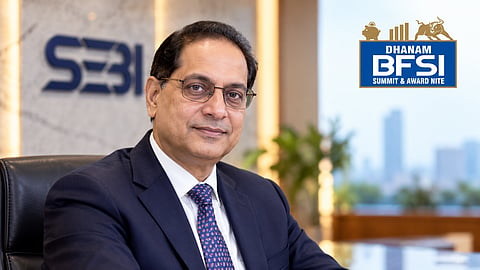

India’s capital market regulator is exploring the development of a domestically governed artificial intelligence (AI) model for the securities market to make secure and affordable AI tools more widely accessible.
Securities and Exchange Board of India (SEBI) is also examining the possibility of setting up an AI sandbox to allow market participants to test new technologies in a controlled environment. (A `sandbox' is an isolated environment where code or software runs safely without affecting the main system or live data.)
SEBI chairman Tuhin Kanta Pandey disclosed this while addressing the ninth edition of the Dhanam BFSI Summit at Le Meridien, Kochi, on November 25. “We are exploring an AI Sandbox to test applications in a controlled environment. We are also examining a domestically governed AI model for the securities market to make secure and affordable AI tools more widely accessible,” he said.
The proposed sandbox would enable market participants to test AI applications before wider deployment, while a homegrown AI model could lower barriers to technology adoption. Both initiatives remain at the exploratory stage.
SEBI is already deploying AI to strengthen regulatory oversight, detect violations and protect investors, Pandey said. Its key initiatives include:
R(AI)DAR: Reviews financial advertisements for regulatory compliance.
Sudarshan: Identifies misleading securities market-related content on social media.
AI-powered compliance monitoring: Tools are being developed to analyse compliance reports and flag potential risks at an early stage.
Pandey, however, cautioned that technology cannot replace human judgement or institutional accountability. Responsible innovation, stronger cybersecurity and effective governance would remain critical as financial markets become increasingly technology-driven.
Despite the rapid expansion of India’s capital markets, a significant gap remains between financial awareness and actual investment participation.
SEBI’s 2025 investor survey revealed that 63% of Indian households were familiar with securities market products, but only 9.5% invested in them. Moreover, just 36% of investors possessed moderate to high market knowledge.
Opening an investment account may take only a few minutes, but understanding investment risks, costs and potential fraud requires considerably more effort, Pandey pointed out.
To bridge this gap, SEBI launched Project Jagruk on October 5, a nationwide investor education campaign covering 13 languages, including Malayalam.
The campaign has recorded 37 crore social media views nationwide. In Keralam alone, it has generated six crore WhatsApp messages and more than three crore Instagram impressions.
Pandey highlighted the growing scale and depth of India’s financial markets, presenting several key indicators.
Equity market capitalisation: Over ₹500 lakh crore
Mutual fund AUM: ₹83 lakh crore
Investor base: Over 15 crore
Corporate bond market: Over ₹62 lakh crore (October 2026)
Alternative Investment Fund (AIF) commitments: Over ₹18 lakh-crore (September 2026)
The expansion of capital markets offers greater opportunities for businesses to raise funds and individuals to participate in wealth creation, making investor education and regulatory safeguards increasingly important.
SEBI is also working to reduce procedural barriers while strengthening investor protection. Remote digital KYC facilities for non-resident Indians (NRIs), Overseas Citizens of India (OCI) cardholders and foreign nationals are among the measures aimed at improving access to Indian financial markets.
Initiatives such as verified UPI handles, trading app identification labels and SEBI Check are aimed at improving investor safety. SCORES 2.0 and the Online Dispute Resolution (ODR) mechanism seek to strengthen investor grievance redressal.
Pandey outlined four broad priorities that would guide the regulator’s approach to the evolving financial landscape.
Capital formation: Expanding fundraising avenues through reforms in IPOs, SME listings, corporate bonds, AIFs, REITs and InvITs.
Financial literacy: Strengthening investor education and enabling informed financial decisions.
Responsible innovation: Exploring AI sandboxes and domestically governed AI tools while ensuring adequate safeguards.
Cybersecurity and governance: Strengthening market infrastructure, regulatory oversight and institutional accountability.
Pandey’s address underscored a larger challenge facing India’s financial sector: ensuring that the rapid expansion of capital markets and technological capabilities is matched by greater financial understanding, stronger regulatory safeguards and sustained investor trust.
