
Businesses worldwide are facing a fresh wave of cost pressures as the US-Israel war on Iran disrupts energy markets and pushes up shipping expenses. With fuel costs surging and freight rates climbing across major trade routes, companies are bracing for a prolonged period of higher transportation costs that could eventually feed into consumer prices.
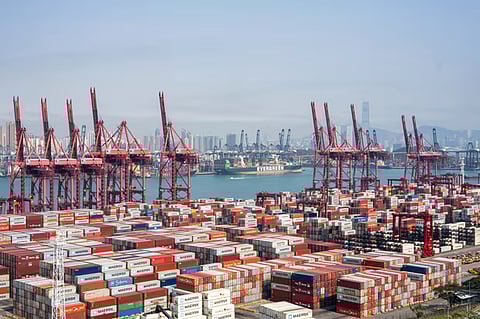
One of the clearest signs of the disruption is the sharp rise in container shipping rates. In Shanghai, one of the world's busiest ports, the Shanghai Containerised Freight Index (SCFI), which tracks spot freight rates across 13 global trade routes, has nearly doubled since late February.
The index climbed from 1,333.11 points at the end of February to 2,571.73 on Friday, indicating that freight rates have risen from around 1.3 times the benchmark level set in 2009 to more than 2.5 times that level.
A similar trend is visible in another key benchmark, Drewry's World Container Index, which tracks freight rates on major East-West shipping routes.
According to data released by Drewry on Thursday, spot rates have increased for four consecutive weeks and now stand at $2,800 per 40-foot container, compared with $1,899 in late February.
Drewry expects freight rates to continue rising in the coming weeks as the early peak shipping season approaches and the fuel crisis shows little sign of easing.
Shipping companies have been among the hardest hit by the global energy shock triggered by the closure of the Strait of Hormuz.
Prices of very low sulphur fuel oil (VLSFO), the primary fuel used by commercial vessels, have risen even faster than Brent crude oil prices.
According to data from maritime trade publication Ship & Bunker, average VLSFO prices at the world's 20 largest bunkering hubs reached $843.5 per tonne on Friday, up by $256 from March 2.
"We are looking at an extra cost bill of half a billion dollars a month," Vincent Clerc, chief executive of shipping giant Maersk, told CNN in early May. He said the company had no option but to pass on the higher costs to customers, describing the situation as "completely unsustainable" otherwise.
Industry experts warn that fuel prices may remain elevated even if the Strait of Hormuz reopens.
Marine fuel supplier Dan-Bunkering said in a recent report that oil prices are likely to remain in the $80-$100 per barrel range during the third and fourth quarters, even assuming shipping traffic through Hormuz resumes.
Meanwhile, Abu Dhabi-based energy producer ADNOC said in May that even if the conflict ended immediately, normal oil flows may not be fully restored until the first quarter of 2027, and possibly not until the second quarter.
The outlook suggests that higher fuel and shipping costs could remain a challenge for global trade and businesses well into next year.

