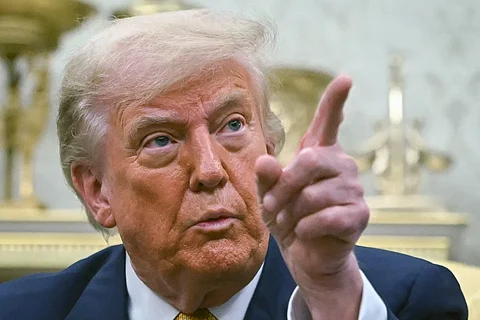

US President Donald Trump has signed a proclamation imposing a 10 percent tariff on all imports into the United States, invoking a rarely used provision of American trade law. The move comes just hours after the US Supreme Court struck down his sweeping tariffs, ruling that he had overstepped executive authority.
In a post on his social media platform, Trump said it was his “great honour” to sign a “Global 10% Tariff on all Countries” from the Oval Office, adding that the measure would take effect almost immediately. The White House later released a fact sheet stating that the President had invoked Section 122 of the Trade Act of 1974 to impose what it described as a temporary import duty.
A few hours before, in a significant judicial rebuke to his trade policy, the Supreme Court of the United States had ruled that Trump exceeded his executive powers in imposing broad-based tariffs without clear congressional authorisation.
The ruling was widely seen as a reaffirmation of Congress’s constitutional authority over taxation and trade, and a warning against expansive interpretations of presidential power. Legal experts had expected that any renewed attempt to impose blanket tariffs would face intense scrutiny.
By relying on Section 122 of the Trade Act of 1974, the administration appears to be seeking a narrower, time-bound legal route to reintroduce tariffs — though the move could once again trigger court challenges.
A universal 10 percent tariff would represent one of the most sweeping trade interventions in recent US history. Such a move could disrupt global supply chains, raise input costs for American manufacturers and retailers, and potentially invite retaliatory measures from major trading partners, including China, the European Union and India.
For India, which has been navigating a complex trade relationship with Washington, the development could have implications for sectors ranging from pharmaceuticals and textiles to engineering goods and IT hardware exports.
While the administration has framed the move as a temporary and legally grounded response to economic imbalances, the fact that Section 122 has never been tested in court leaves substantial uncertainty.
Given the Supreme Court ruling curbing presidential tariff powers, legal analysts expect swift challenges from importers, industry groups and possibly lawmakers. The coming days could determine whether this latest tariff order survives judicial scrutiny — or becomes the next flashpoint in the ongoing battle over executive authority and US trade policy.
Section 122 directs the President to take measures, including a temporary import surcharge, when necessary to address “large and serious” US balance-of-payments deficits or other “fundamental international payments problems”.
According to the Congressional Research Service, the provision has never previously been used, and courts have not interpreted its scope. Some legal analyses suggest that, on paper, it could permit across-the-board tariffs in certain circumstances.
However, the law imposes clear limits:
The tariff can remain in force for no more than 150 days.
The rate cannot exceed 15 percent.
The White House fact sheet states that the new 10 percent duty will apply to all imports from every country for a period of 150 days. The measure is set to take effect at 12:01 am Eastern Time on Tuesday, February 24.
