
India and the United States appear to be heading towards a breakthrough in their long-pending trade negotiations, with Washington signalling that only a handful of issues remain unresolved.
The renewed optimism comes as temporary relief from US sanctions linked to Russian oil purchases creates a more favourable environment for concluding an agreement that could reshape trade relations between the two countries.
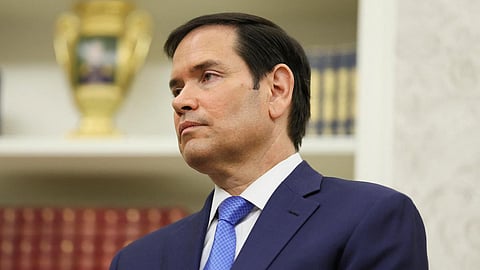
US Secretary of State Marco Rubio said on Tuesday that the two countries were close to finalising the bilateral trade agreement, raising expectations of a formal announcement in the coming weeks.
Speaking to reporters in Mumbai, Rubio said the negotiations had reached an advanced stage, with only a few outstanding matters requiring attention.
“We’re about as close as you can be without an executed agreement. I think there’s a small number of items left to wrap up, so I think that (the deal) will happen shortly,” Rubio said.
He also expressed confidence that the two governments would reach an agreement soon.
Rubio's visit to India comes at a crucial stage in bilateral relations, with trade, energy security, defence cooperation and critical technologies dominating the discussions.
During his meeting with External Affairs Minister S Jaishankar in Mumbai, the two leaders reviewed progress in bilateral cooperation and discussed regional and international developments, including the situation in West Asia.
Rubio clarified that although the State Department does not directly negotiate trade agreements, it remains closely involved in discussions involving national security and strategic interests.
One of the major developments supporting the negotiations is the temporary relaxation of US sanctions targeting countries purchasing Russian oil.
President Donald Trump recently approved a 60-day pause on certain secondary sanctions affecting major buyers of Russian crude, including India and China.
The move has reduced immediate uncertainty surrounding India's energy imports and eased a significant source of friction between New Delhi and Washington.
Rubio had earlier indicated that progress in the India-US trade negotiations was among the factors considered when Washington decided to provide sanctions relief.
However, the relaxation remains temporary, and the possibility of renewed restrictions continues to create uncertainty for Indian refiners and energy importers.
India has already indicated that the first phase of the bilateral trade agreement is substantially complete.
Commerce and Industry Minister Piyush Goyal said last week that the initial tranche had been finalised and was undergoing legal drafting.
The government expects to conclude the remaining formalities soon, although implementation will depend on whether the agreement provides Indian exporters with a competitive advantage in the American market.
Goyal has maintained that India should receive treatment comparable to, or better than, that available to competing exporting countries.
Despite progress in negotiations, several tariff-related challenges remain unresolved.
The US has imposed an additional 10% duty on Indian imports under Section 301 of the US Trade Act following an investigation into the enforcement of restrictions on goods produced using forced labour.
The final duty was reduced from an earlier proposed rate of 12.5%, placing India in a relatively lower tariff category.
Separately, the Office of the US Trade Representative is investigating India and several other economies over alleged structural excess manufacturing capacity.
The outcome of this investigation could influence the broader American tariff framework and affect the competitiveness of Indian products in the US market.
New Delhi is therefore seeking greater clarity on the overall tariff structure before formally concluding the agreement.

