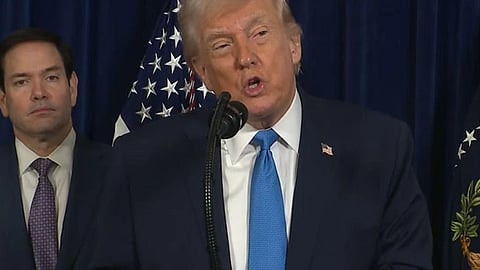

Donald Trump has said the United States will effectively “run” Venezuela for a temporary period and overhaul its oil sector, following a dramatic military operation that led to the capture of Venezuelan President Nicolás Maduro.
Speaking after the US strikes, Trump said Washington would oversee Venezuela until a “safe, proper and judicious transition” is put in place. He added that major US oil companies would be brought in to repair the country’s oil infrastructure and revive production, claiming this would help Venezuela “start making money again”.
The comments came after US forces carried out strikes in the early hours of Saturday, capturing Maduro and his wife Cilia Flores, in Caracas. The two were flown out of the country and then flown to New York.
US Attorney General Pam Bondi said Maduro and Flores have been indicted in the Southern District of New York. The charges include conspiracy to commit narco-terrorism, cocaine trafficking, and possession of machine guns and destructive devices. Bondi said the pair would face trial in US courts, calling it a major step in Washington’s long-running case against the Venezuelan leadership.
Maduro has consistently denied allegations linking him to drug cartels, accusing the US of using the “war on drugs” as a pretext to remove him and gain control over Venezuela’s vast oil reserves.
At a news conference, Trump described Venezuela’s oil industry as “a total bust” and said US energy companies would invest billions of dollars to fix what he called “badly broken” oil infrastructure. Venezuela holds an estimated 303 billion barrels of crude oil, about one-fifth of global proven reserves, according to US energy data.
Trump did not give details on how the US would govern Venezuela during the transition, saying only that a “group” would be responsible for running the country. He claimed US secretary of state Marco Rubio had been in contact with Venezuelan vice-president Delcy Rodríguez, suggesting she was open to cooperating with Washington.
However, Rodríguez later appeared on state television, insisting Maduro remains Venezuela’s only legitimate president and saying the country was ready to defend itself. Caracas has declared a state of national emergency and condemned the US action as military aggression.
International reaction has been sharply divided. Russia and China strongly criticised the strikes, while several Latin American nations, including Brazil and Colombia, also voiced concern. US allies in Europe struck a more cautious tone, calling for a peaceful transition that reflects the will of the Venezuelan people, even as questions mount over the legality and wider economic fallout of Washington’s unprecedented move.

