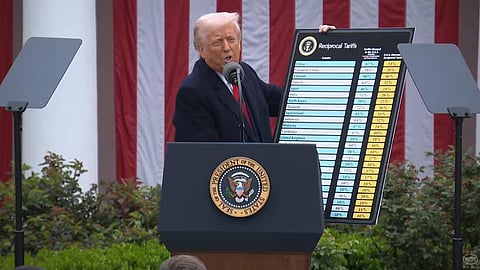

Donald Trump’s new 10 percent global tariff came into effect on February 24, just days after the Supreme Court blocked many of his earlier sweeping import duties.
The move follows a 6-3 ruling by the Supreme Court of the United States on Friday, which held that Trump had overstepped his authority by imposing wide-ranging global tariffs last year under emergency powers.
Within hours of the verdict, Trump signed an executive order bringing in a fresh 10 percent levy on imports from all countries. He has since warned that the tariff could be raised to 15 percent, though no formal order has yet been issued.
The White House is now invoking Section 122 of the Trade Act of 1974 to impose the duty. This provision allows the president to introduce temporary import restrictions for up to 150 days without approval from Congress.
The earlier tariffs had been imposed under the International Emergency Economic Powers Act (IEEPA), a 1977 law that gives the president broad authority during national emergencies.
However, the Supreme Court ruled that using the IEEPA to justify sweeping global tariffs exceeded presidential powers.
The executive order said the new tariff is intended to address “fundamental international payments problems” and re-balance US trade relationships in favour of American workers, farmers and manufacturers.
Trump has repeatedly argued that tariffs are necessary to reduce the US trade deficit — the gap between imports and exports.
Despite these measures, the US trade deficit widened by 2.1 percent compared with 2024, reaching about $1.2 trillion last week.
According to official data, the US has already collected at least $130 billion in tariffs under the earlier IEEPA-based measures.
Trump sharply criticised the court ruling, calling it “ridiculous” and “extraordinarily anti-American”. On Monday, he warned that countries which “play games” with recent trade deals could face higher tariffs.
The ruling has created uncertainty across global markets, with governments reviewing the status of their trade arrangements with Washington.
The UK said it would keep all options open if the US failed to honour its tariff deal, though it stressed that no one wanted a trade war. The European Union said it would suspend ratification of a summer trade agreement.
India has also deferred previously scheduled talks aimed at finalising a recent trade pact with the US.
The latest move signals that despite the judicial setback, Trump is pushing ahead with his protectionist trade agenda, setting the stage for renewed global trade tensions.

