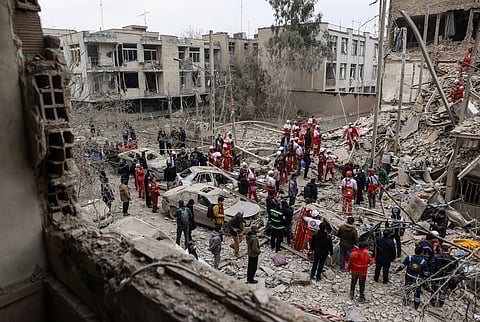

China has sharply criticised the ongoing US-Israel military campaign against Iran, calling it an “unjust war” and pushing for an immediate ceasefire, even as global tensions and energy risks escalate.
In a call with a senior French official, Chinese Foreign Minister Wang Yi urged coordinated international efforts to halt the conflict and prevent further escalation, South China Morning Post reported.
He said countries, particularly members of the United Nations Security Council, must work together to uphold international law and avoid a slide into what he described as a “law of the jungle”.
Key priorities outlined by Beijing include:
Preventing the conflict from spreading to other nations
Building consensus for an immediate ceasefire
Stepping up mediation efforts through the United Nations
China also signalled willingness to coordinate with France to contain the crisis.
Wang’s remarks mark the first time Beijing has officially described the Iran conflict as an “unjust war” — a term historically associated with criticism of the Iraq War.
Chinese officials reiterated that military force would not resolve the crisis and warned that prolonged conflict would deepen regional instability and humanitarian suffering.
The conflict, involving United States and Israel against Iran, has now entered its fourth week, with signs of spillover across the region.
Reports indicate:
Over 1,400 deaths in Iran
More than 18,000 injured
Widespread damage to civilian infrastructure
The war is increasingly rattling global energy markets. Disruptions around the Strait of Hormuz — through which roughly one-fifth of global oil and gas supplies pass — have pushed prices sharply higher.
In response, the United States has:
Issued a temporary 30-day waiver allowing purchases of Iranian oil already in transit
Earlier permitted limited transactions involving Russian oil shipments
These steps are aimed at easing supply pressures and stabilising global markets.
The crisis is also affecting major geopolitical engagements. US President Donald Trump has reportedly sought to delay a planned meeting with Chinese President Xi Jinping by several weeks.
Even as Washington signalled a possible “winding down” of operations, China has intensified diplomatic outreach, engaging with other permanent members of the Security Council to push for de-escalation.
China’s sharper rhetoric reflects a broader attempt to position itself as a stabilising diplomatic force, while highlighting the economic risks of prolonged conflict — particularly to global energy supplies and emerging markets.
For now, however, the gap between calls for ceasefire and developments on the ground remains wide.

