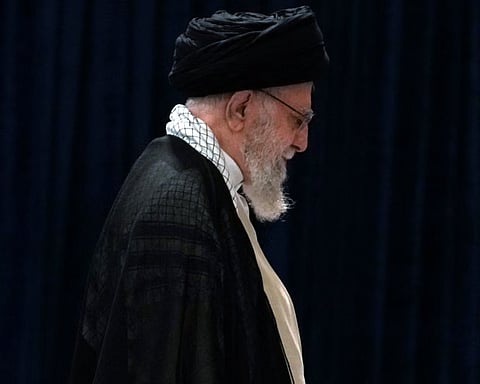

Iranian state media early on Sunday confirmed the killing of Supreme Leader Ali Khamenei in large-scale missile and air strikes carried out by the US and Israel, marking a dramatic escalation in the conflict and plunging the region into deeper uncertainty.
The confirmation came hours after US President Donald Trump declared on his Truth Social platform that Khamenei was dead, describing him as “one of the most evil people in history”. Trump said the strikes were part of a military campaign launched on Saturday morning and framed the operation as an effort to trigger regime change in Iran.
Khamenei, who had led the Islamic Republic since 1989, had not been seen publicly since the first wave of strikes began. Satellite images circulating on social media appeared to show extensive damage to his secure compound in Tehran.
Trump claimed that multiple senior Iranian leaders were killed in the opening barrage. “The people that make all the decisions, most of them are gone,” he told NBC, adding that the campaign represented a “chance for the Iranian people to take back their country”.
Israeli Prime Minister Benjamin Netanyahu earlier said there were “many signs” that Khamenei was no longer alive. Israeli officials briefed domestic media that his body had been recovered.
Iranian outlets also reported that members of Khamenei’s immediate family — including his daughter, son-in-law and granddaughter — were killed in the strikes. The semi-official Fars news agency cited sources close to the family in confirming the deaths.
Early Sunday, the Israeli military said it had launched a new wave of attacks targeting Iran’s ballistic missile infrastructure and air defence systems. US Central Command said it was delivering “swift and decisive action as directed”.
The joint US-Israeli offensive began with coordinated missile and air strikes across multiple Iranian cities on Saturday. The scale of the operation has raised fears of a prolonged regional war, with no clear timeline or defined endgame.
Netanyahu said Israeli strikes had also eliminated several figures associated with Iran’s nuclear programme, adding that operations against related facilities would continue in the coming days.
In a televised address, Trump said the operation — named “Operation Epic Fury” — was aimed at neutralising a security threat to the US and encouraging internal dissent in Iran. Netanyahu, in a separate address, called on Iranians to “flood the streets”.
Iranian media reported that at least 201 people were killed and 747 injured in the initial strikes. Among the dead were reportedly more than 80 children at a school hit during the bombardment, though independent verification was not immediately available.
Iranian officials warned that the consequences of the attacks would be “long-lasting and extensive”, saying all response options were under consideration.
The IRGC threatened retaliation against US military bases and interests across the region, stating that operations would continue until “the enemy is decisively defeated”.
Iran has since launched missile and drone attacks targeting US and Israeli-linked sites. These reportedly included the headquarters of the US Navy’s Fifth Fleet in Bahrain, residential areas in Israel, and selected targets in Gulf countries, including a hotel in Dubai and a high-rise building in Bahrain.
US Central Command said American forces had intercepted hundreds of incoming missiles and drones and that no US casualties had been reported.
A senior Trump administration official said Washington chose to strike on Saturday because Iran’s ballistic missile capabilities posed what he described as an “intolerable” threat to US forces and allies. The official also claimed intelligence suggested Iran was considering a pre-emptive attack.
“The president decided he was not going to sit back and allow American forces in the region to absorb attacks from conventional missiles,” the official said, adding that US forces had been effective in targeting Iranian launchers.
Khamenei’s death creates a power vacuum at the apex of Iran’s political and religious hierarchy. Under the constitution, the Assembly of Experts — a clerical body — is tasked with appointing a new supreme leader. However, analysts suggest that the ultraconservative IRGC could seek to consolidate control during any transitional period.
Khamenei wielded unmatched authority over Iran’s military, judiciary and key political institutions for nearly four decades. His removal in a direct foreign strike marks one of the most consequential moments in the history of the Islamic Republic.
The coming days are likely to determine whether the conflict expands into a broader regional confrontation or settles into a prolonged and volatile standoff.

