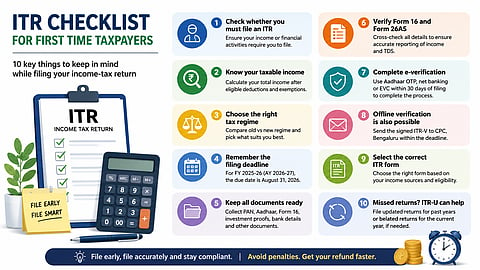

With the deadline for filing income-tax returns (ITR) for the financial year 2025-26 (assessment year 2026-27) extended to August 31, first-time taxpayers have more time to complete the process. However, waiting until the last minute could lead to technical glitches, errors and delayed refunds. A little preparation can make filing your first return quick and hassle-free.
The Income Tax Department has already enabled the Excel utilities for ITR-1, ITR-2, ITR-3, ITR-4, ITR-5 and ITR-7, allowing taxpayers to prepare returns offline before uploading them through the e-filing portal.
Avoid heavy traffic on the e-filing portal near the deadline
Get tax refunds processed faster
Have enough time to correct mistakes or respond to notices
Reduce the risk of missing mandatory documents
Filing an income-tax return is mandatory if your income exceeds the prescribed exemption limit. You may also need to file a return if you meet certain specified financial criteria, including:
Holding assets in India or abroad
Investing in shares, securities or ESOPs
Bank deposits exceeding ₹50 lakh
Savings or current account transactions exceeding ₹1 crore
Annual electricity bills above ₹1 lakh
Overseas travel expenditure above ₹2 lakh
Business sales exceeding ₹60 lakh
Your taxable income is calculated after deducting eligible exemptions and deductions from your total income.
Besides salary, taxable income may include:
Interest from bank deposits
Capital gains
Dividend income
Rental income
Other taxable earnings
Eligible deductions may include investments in:
Public Provident Fund (PPF)
National Pension System (NPS)
Life insurance
Home loan interest
Other tax-saving investments
Taxpayers can opt for either the old tax regime or the new tax regime.
The better option depends on:
Your salary level
Eligible deductions and exemptions
Tax-saving investments
Using an online tax calculator or consulting a chartered accountant can help identify the more tax-efficient option.
For FY 2025-26 (AY 2026-27):
Due date for filing without penalty: August 31, 2026
Belated returns can be filed up to December 31, 2026
Late filing may attract a penalty depending on the delay and tax payable
Before starting the filing process, keep these documents handy:
PAN card
Aadhaar card (linked with PAN)
Form 16 from your employer
Bank account details
Investment proof
Home loan interest certificate, if applicable
Insurance premium receipts
Details of other income
Do not rely only on Form 16.
Cross-check the following:
Form 16 issued by your employer
Form 26AS
Annual Information Statement (AIS)
These documents help verify:
Tax deducted at source (TDS)
Interest income
Dividend income
Securities transactions
Foreign remittances
Other reported financial transactions
Matching these records reduces the chances of receiving tax notices later.
Filing is not complete until the return is verified.
You can e-verify using:
Aadhaar OTP
Net banking
Electronic Verification Code (EVC)
Failure to complete verification within 30 days could delay processing of the return and any refund due.
Those unable to complete e-verification can verify their return by sending the signed ITR-V acknowledgement to the Centralised Processing Centre (CPC) in Bengaluru within the prescribed time limit.
Choosing the wrong form may result in rejection of the return.
The commonly used forms include:
ITR-1 (Sahaj): Salaried individuals with one house property and income from other sources
ITR-2: Individuals and Hindu Undivided Families (HUFs) without business income
ITR-3: Individuals or HUFs having business or professional income
ITR-4 (Sugam): Taxpayers opting for the presumptive taxation scheme
The Income Tax e-filing portal also offers a "Help me decide" feature to guide users to the appropriate form.
Taxpayers who failed to file returns for any of the previous assessment years can use the updated return facility (ITR-U), subject to applicable conditions.
For the current assessment year, taxpayers who miss the August 31 deadline can still submit a belated return, although they may have to pay a late filing fee and interest on any outstanding tax liability.
For first-time taxpayers, the income-tax filing process can appear complicated, but proper preparation makes it much easier. Keeping the necessary documents ready, selecting the correct form, reconciling tax details with Form 26AS and AIS, and completing verification on time can help avoid penalties, delays and unnecessary compliance issues. Filing well before the deadline also leaves enough room to correct mistakes, if any.

