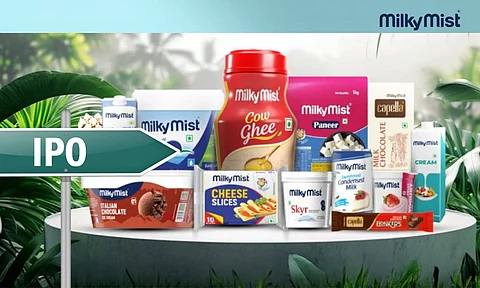

Milky Mist is not a conventional milk company. Its focus is on value-added dairy products such as paneer, cheese and yoghurt. As its ₹1,553 crore IPO opens, here are the key factors investors should consider.
India's dairy market is changing rapidly. Consumers are increasingly moving beyond traditional liquid milk to branded, packaged and value-added products, creating room for companies that can build strong brands in categories such as paneer, cheese, yoghurt and ice cream.
Milky Mist Dairy Food is one such company. The Tamil Nadu-based dairy products maker has built a sizeable business without entering the highly competitive liquid milk market. Its ₹1,553 crore initial public offering (IPO) opened for subscription on August 11 and will close on August 13.
The IPO has a price band of ₹133-140 a share. At the upper end, the company is valued at about ₹10,778 crore. The issue comprises a fresh issue of ₹1,428 crore and an offer for sale (OFS) of ₹125 crore.
Here are some key points investors should know before taking a call on the issue.
The name may suggest a conventional dairy company, but liquid milk is not the focus of Milky Mist's business.
Instead, the company concentrates on value-added dairy products, which typically offer greater scope for branding and product differentiation.
Its portfolio includes:
Paneer
Cheese
Curd and yoghurt
Greek yoghurt
Butter
Ghee
Ice cream
Other value-added dairy products
This positioning has allowed Milky Mist to avoid direct competition in the low-margin liquid milk segment and build a presence in premium and processed dairy categories.
Milky Mist has expanded rapidly in recent years, with revenue rising from about ₹1,394 crore in FY23 to more than ₹2,300 crore in FY25.
The growth accelerated further in FY26. Revenue reached around ₹3,138 crore, while net profit increased to about ₹127 crore.
The improvement in profitability is particularly important because the company had reported much lower profits in earlier years.
The sharp increase in profit suggests that the company is beginning to benefit from scale and a greater contribution from value-added products.
Milky Mist has built a strong position in several organised dairy categories. It has a leading position in packaged paneer and is particularly strong in the South Indian cheese market. Its Greek yoghurt business is also significant, with an estimated 35-40 percent share of the organised Greek yoghurt market in FY26.
However, there is a geographical concentration that investors need to consider. Nearly 70 percent of the company's revenue comes from South India. While this gives Milky Mist a strong base, expanding in northern and western India will be important if the company wants to sustain its growth rate.
A major attraction of the issue is the fresh capital being raised.
Of the ₹1,553 crore IPO, ₹1,428 crore will come through a fresh issue, while ₹125 crore will be raised through an OFS. The fresh funds will be used mainly for capital expenditure and repayment of borrowings.
The company plans to expand manufacturing capacity and strengthen its processing infrastructure.
It is also investing in cold-chain infrastructure, which is crucial for a business dealing extensively in perishable dairy products.
For investors, debt reduction could be particularly important. Lower borrowings could reduce interest costs and improve the company's balance sheet over time.
Milky Mist received about ₹482 crore in a pre-IPO funding round led by Jongsong Investments, an affiliate of Singapore-based Temasek Holdings. The investment included both fresh capital and a secondary share sale.
The participation of a large global institutional investor provides an additional layer of credibility to the company's growth story. It also indicates that institutional investors see potential in India's organised and value-added dairy market.
Milky Mist has also attracted strong institutional interest ahead of the IPO, raising about ₹465 crore from anchor investors before the issue opened.
The biggest question for investors is not whether Milky Mist is growing. It clearly is. The question is whether the IPO valuation adequately reflects that growth.
At ₹140 a share, the company is valued at about ₹10,778 crore. Based on FY26 earnings, the valuation works out to a high earnings multiple, making the stock relatively expensive compared with its current profit base.
That means investors are effectively paying a premium for future growth.
The positives include:
Rapid revenue growth
Strong improvement in profitability
Established brands in value-added dairy
Leading positions in selected categories
Expansion opportunities across India
Debt reduction through IPO proceeds
Institutional backing
The risks include:
High IPO valuation
Dependence on South India
Strong competition in the dairy market
Capital-intensive expansion
Dependence on sustained high growth to justify the valuation
Milky Mist's IPO is different from that of a traditional dairy company. The company's strategy is centred on moving up the value chain rather than competing in the liquid milk market.
Its recent financial performance, strong position in selected categories and expansion plans provide a compelling growth story. But the IPO valuation leaves relatively little room for disappointment.
For investors, the issue is therefore not simply a bet on Milky Mist's brand. It is a bet on whether India's shift towards branded, packaged and value-added dairy products can continue to deliver the kind of growth needed to justify the company's premium valuation.
Disclaimer: This article is for readers' education. Consult your financial advisor before making an investment decision.

