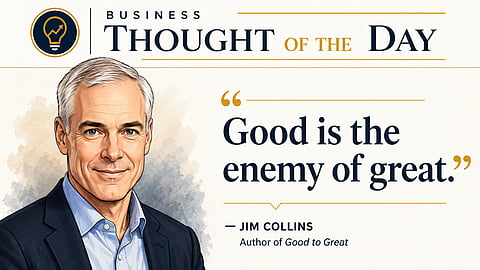

Jim Collins is one of the world's most influential management thinkers and business authors. A former faculty member at Stanford Graduate School of Business, he left academia to pursue independent research into what distinguishes exceptional companies from average ones. Rather than relying on personal opinions or management fads, Collins built his reputation through rigorous, data-driven studies spanning decades. His books have become essential reading for business leaders, entrepreneurs and corporate executives across the world.
This quote is drawn from Jim Collins' bestselling Good to Great, in which he argues that many organisations fail to become exceptional not because they lack talent or opportunity, but because they become comfortable with being merely good. When a business is profitable and reasonably successful, there is often less urgency to innovate, improve efficiency or rethink strategy. Over time, that comfort can turn into complacency.
History is full of companies that dominated their industries but gradually lost their edge because they assumed yesterday's strengths would guarantee tomorrow's success. Meanwhile, competitors invested in better products, new technologies and stronger customer experiences. The companies that endured were those that treated success as a starting point rather than a destination.
For business owners, the lesson is clear: continuous improvement should become part of the organisation's culture. Whether it means adopting artificial intelligence, investing in employee skills, strengthening governance or improving customer service, incremental improvements made consistently often produce remarkable long-term results.
The message is equally relevant for small and medium enterprises. Many family-owned businesses reach a comfortable level of profitability and stop investing in innovation. However, changing consumer preferences, digital commerce and increasing competition demand constant adaptation. Businesses that regularly question their assumptions and seek better ways of operating are more likely to achieve sustainable growth.
Leadership also plays a decisive role. Great leaders encourage teams to challenge existing processes, embrace new ideas and learn from setbacks. They understand that excellence is never a finished achievement but an ongoing pursuit.
Collins is best known for his international bestseller Good to Great, which has sold millions of copies and been translated into dozens of languages. The book introduced concepts such as 'Level 5 Leadership', the 'Hedgehog Concept' and the 'Flywheel Effect'—ideas that continue to influence corporate strategy and leadership development. Beyond writing, Collins has advised CEOs of major corporations as well as leaders of government agencies, educational institutions and non-profit organisations. His enduring message is that greatness is rarely the result of a single breakthrough; it is built through disciplined people, disciplined thinking and disciplined action sustained over many years.
Jim Collins' simple yet profound observation is a reminder that success should never breed complacency. In business, being "good enough" may secure today's results, but only a relentless commitment to improvement creates enduring greatness. For entrepreneurs aiming to build lasting enterprises, the journey from good to great begins with refusing to settle.

