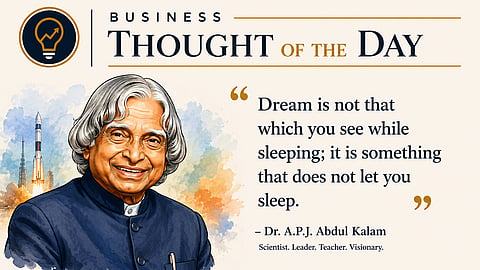

"Dream is not that which you see while sleeping; it is something that does not let you sleep."
—APJ Abdul Kalam
Everyone dreams. Some dream of building a successful business, others of creating a new product, leading a company or transforming society. Yet dreams, by themselves, achieve very little. They become meaningful only when they refuse to let us rest—when they demand effort, discipline and perseverance.
Few people embodied this idea more completely than APJ Abdul Kalam. His famous quote has inspired millions of young Indians. It is often repeated at graduation ceremonies and leadership seminars, but its message extends far beyond motivation. It is a reminder that genuine ambition is restless. It pushes us to learn, innovate, fail, improve and keep moving forward.
For entrepreneurs, executives and professionals, this is perhaps one of the most practical definitions of leadership. A vision that remains inside the mind is merely a wish. A vision translated into action becomes progress.
Born in 1931 in the temple town of Rameswaram in Tamil Nadu, Avul Pakir Jainulabdeen Abdul Kalam came from a humble family. Young Kalam contributed to the family's income by selling newspapers before and after school. His fascination with mathematics and science eventually led him to study aerospace engineering, setting him on a path that would shape India's technological future.
At Indian Space Research Organisation (ISRO) he played a pivotal role in developing India's first indigenous Satellite Launch Vehicle. Later, he became closely associated with the country's missile development programme, earning the affectionate title "Missile Man of India". His contributions to India's defence and space capabilities made him one of the nation's most respected scientists. In 2002, he became the 11th President of India, serving until 2007. Unlike many public figures, he remained approachable throughout his life, interacting regularly with students and encouraging them to dream big.
One reason Kalam's words continue to resonate is that they reject passive optimism. He never suggested that success comes simply from dreaming. Rather, he believed dreams should ignite action.
History is full of people who imagined extraordinary possibilities. The ones we remember are those who worked tirelessly to make those possibilities real. Every successful enterprise begins as an idea in someone's mind. But the journey from imagination to achievement requires planning, experimentation, teamwork and relentless execution.
Businesses often spend considerable time crafting ambitious vision statements. These have value only when they influence everyday decisions. A company's purpose should guide product development, customer service, hiring, innovation and investment. Otherwise, vision becomes little more than decorative language on a corporate website.
Kalam was, above all, a scientist. He believed that curiosity was the engine of innovation. He encouraged young people not merely to memorise facts but to ask questions, challenge assumptions and explore new possibilities.
This mindset is equally important in business. Markets evolve rapidly. Technologies become obsolete. Customer expectations shift continuously. Organisations that encourage curiosity are better prepared to adapt than those content with yesterday's success.
Innovation does not always mean inventing revolutionary technology. Sometimes it means finding a better way to serve customers, simplifying a process, reducing waste or discovering an overlooked opportunity. The businesses that endure are often those that remain curious long after they become successful.
He believed India's greatest resource was neither its minerals nor its industries but the imagination and energy of its youth. That message has become even more relevant today. India is witnessing an unprecedented wave of entrepreneurship. Young founders are building companies in artificial intelligence, biotechnology, fintech, manufacturing, clean energy and countless other fields. Their greatest advantage is not age but their willingness to question convention and embrace change.
Kalam understood that economic growth is ultimately driven by people who dare to attempt what others consider impossible. Every thriving startup ecosystem begins with individuals who choose action over hesitation.
One remarkable aspect of Kalam's life was that his ambitions always extended beyond personal achievement. Progress, in his eyes, was meaningful only if it improved people's lives.
Kalam reminds us that dreams are not escapes from reality—they are commitments to shape it. They challenge us to replace comfort with curiosity, intention with action and ambition with disciplined execution. In business, as in life, the dreams that keep us awake are often the ones that leave the deepest mark on the world.

