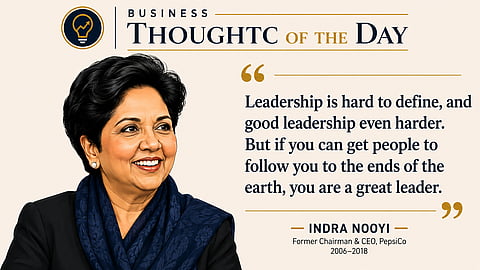

"Leadership is hard to define, and good leadership even harder. But if you can get people to follow you to the ends of the earth, you are a great leader."--Indra Nooyi
Few business leaders have reshaped a global company while also changing the conversation around corporate responsibility as profoundly as Indra Nooyi. She rose through determination, education and relentless hard work to become one of the world's most respected CEOs, leading PepsiCo from 2006 to 2018.
When Nooyi took charge, PepsiCo was already a global giant. Yet she believed that simply selling more snacks and soft drinks was not enough to ensure the company's future. Consumer preferences were changing, health concerns were growing, and sustainability was becoming an increasingly important business issue. Rather than chasing short-term gains, she chose to prepare the company for the decades ahead.
Born in Chennai in 1955, Indra Nooyi grew up in a middle-class family that placed a strong emphasis on education and ambition. She earned a bachelor's degree in physics, chemistry and mathematics from Madras Christian College, followed by a postgraduate diploma in management from the Indian Institute of Management Calcutta. Determined to broaden her horizons, she moved to the United States to pursue a master's degree in Public and Private Management at Yale University. After holding senior strategy roles at companies including Boston Consulting Group, Motorola and Asea Brown Boveri (ABB), she joined PepsiCo in 1994. Her strategic vision and leadership saw her rise to President and Chief Financial Officer before becoming the company's Chief Executive Officer in 2006, making her one of the most influential business leaders in the world.
Her strategy, called "Performance with Purpose", aimed to deliver strong financial results while making PepsiCo healthier, more environmentally responsible and a better place to work. The company invested in nutritious products, reduced salt, sugar and saturated fat in many of its offerings, improved water efficiency, cut packaging waste and strengthened its commitment to employee development.
The strategy was not universally welcomed at first. Some investors questioned whether focusing on sustainability would dilute profitability. Nooyi remained steadfast, arguing that companies could not thrive in the long run if they ignored society's evolving expectations.
History largely vindicated her approach. During her tenure, PepsiCo's revenues grew substantially, profitability improved, and shareholder value increased significantly. More importantly, she demonstrated that businesses do not have to choose between commercial success and responsible leadership. They can pursue both.
Nooyi also became a role model for aspiring leaders around the world. As one of the few women to lead a Fortune 50 company, she often spoke openly about balancing career ambitions with family responsibilities. She emphasised empathy, listening and authenticity as essential leadership qualities, challenging the notion that effective leaders must always project toughness.
Her career offers an important lesson for entrepreneurs and executives alike. Competitive advantage does not come only from cutting costs or increasing sales. It also comes from anticipating change before competitors do. Businesses that invest in innovation, people and sustainability are often better positioned to navigate disruption.
In an era when companies face rapid technological shifts, environmental challenges and changing customer expectations, Nooyi's philosophy remains highly relevant. Her legacy reminds us that leadership is measured not only by quarterly results but also by the strength and resilience of the organisation left behind.
Success is not simply about reaching the top. It is about ensuring that the journey creates lasting value for customers, employees, shareholders and society.

