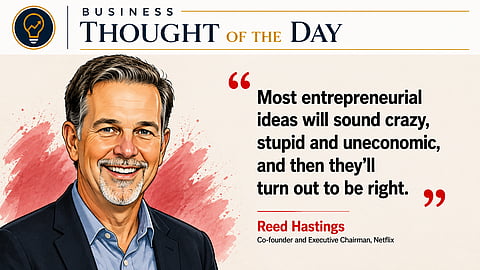

"Most entrepreneurial ideas will sound crazy, stupid and uneconomic, and then they'll turn out to be right."
— Reed Hastings, co-founder and executive chairman, Netflix
History shows that many revolutionary business ideas were initially dismissed as unrealistic. Few believed people would shop online, pay for rides through a smartphone app or watch movies over the internet instead of renting DVDs. Yet these "impossible" ideas reshaped entire industries. Reed Hastings' observation captures one of the most important truths of entrepreneurship: breakthrough innovation often begins as an idea that most people fail to understand.
Successful entrepreneurs do not merely follow market trends; they anticipate where the market is heading. They identify opportunities hidden beneath conventional thinking and have the courage to act before others see the potential. While criticism is inevitable, genuine innovation demands conviction, patience and the willingness to persevere through uncertainty.
Reed Hastings co-founded Netflix in 1997 with Marc Randolph as a DVD-by-mail rental service, offering customers a more convenient alternative to traditional video rental stores. At the time, the dominant players in home entertainment were physical rental chains, and the idea of receiving DVDs by post seemed unconventional.
What distinguished Hastings, however, was not simply building a successful business—it was his willingness to reinvent it repeatedly. Instead of protecting Netflix's profitable DVD business, he shifted the company towards subscription-based rentals, then embraced internet streaming long before broadband became widespread. Later, he made another bold move by investing billions in original programming, transforming Netflix from a content distributor into one of the world's largest entertainment producers.
Today, Netflix serves hundreds of millions of subscribers across the globe and has fundamentally changed how audiences consume entertainment.
Long before Netflix, Hastings founded Pure Software, a company specialising in software development tools. Although Pure Software became successful and was eventually acquired, Hastings later admitted that managing a rapidly growing company taught him valuable lessons about leadership, organisational culture and decision-making.
A mathematics graduate from Bowdoin College, Hastings also spent two years as a Peace Corps volunteer in rural Eswatini (then Swaziland), teaching mathematics in local schools. He has often credited that experience with shaping his leadership philosophy. Working with limited resources taught him resilience, patience and the importance of solving problems through continuous learning rather than seeking quick solutions.
These experiences laid the foundation for the leadership style that would later define Netflix.
Perhaps Hastings' greatest strength has been his readiness to disrupt his own success. Many companies fail because they cling to business models that once worked. Hastings chose the opposite approach. He believed that if a business is not willing to reinvent itself, competitors eventually will.
Equally influential has been Netflix's famous corporate culture of "Freedom and Responsibility." Rather than relying on rigid rules and excessive supervision, Hastings created an environment where talented employees enjoy significant autonomy while being held to exceptionally high standards of accountability. His management philosophy has become a case study in business schools and has inspired organisations around the world to rethink workplace culture.
Every disruptive innovation begins with doubt. Investors question it, experts dismiss it and competitors often ignore it—until it succeeds. The entrepreneurs who ultimately change industries are those who combine bold vision with disciplined execution, constantly refining their ideas without losing faith in them.
Reed Hastings reminds us that business success rarely comes from doing what everyone already accepts as sensible. It comes from seeing possibilities that others cannot yet imagine—and having the courage to pursue them. Today's "crazy" idea may well become tomorrow's global success story.

