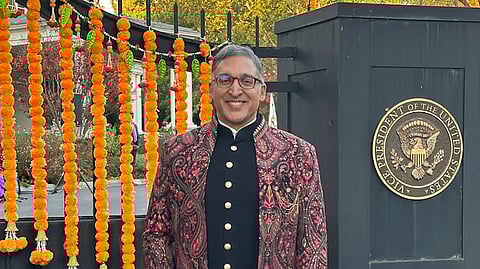

When the US Supreme Court delivered its 6–3 verdict striking down Donald Trump’s sweeping tariff order, one figure stood at the centre of the legal storm: Neal Katyal, the Indian-origin lawyer who framed the battle not as a partisan clash, but as a test of constitutional boundaries.
The ruling held that the 1977 International Emergency Economic Powers Act does not authorise a president to impose tariffs. In doing so, the court dismantled a key pillar of Trump’s trade strategy and reaffirmed that the power to levy taxes and duties lies with Congress. For Katyal, the outcome was less about defeating a president and more about defending the architecture of American democracy.
Born in Chicago to immigrant parents from India, Katyal went on to study at the prestigious Yale Law School, where he served as an editor of the Yale Law Journal. During his time there, he worked closely with noted constitutional scholars Akhil Amar and Bruce Ackerman, collaborating with them on articles published in leading law reviews and political journals in 1995 and 1996.
After earning his Juris Doctor degree in 1995, he clerked for Judge Guido Calabresi on the US Court of Appeals for the Second Circuit, and later for Justice Stephen Breyer at the US Supreme Court.
Katyal has built a career around high-stakes constitutional questions. He has argued more than 50 cases before the Supreme Court — a rare distinction — and served as Acting Solicitor General under President Barack Obama. Today, he balances roles as a partner at Milbank LLP and a professor at Georgetown University, combining courtroom advocacy with academic influence.
In the tariff case, Katyal represented small businesses that argued they were unfairly burdened by duties imposed under a sweeping interpretation of emergency powers. The administration maintained that the tariffs were justified under economic emergency authority. Katyal’s counter was rooted in first principles: the Constitution assigns taxation powers to Congress, and statutory language cannot be stretched to override that design.
What made the judgment especially striking was its breadth. In a deeply polarised era marked by narrow 5–4 splits, the court’s 6–3 ruling included two justices appointed by Donald Trump. For Katyal, that margin underscored the case’s constitutional clarity.
Colleagues describe him as meticulous, measured and institutionally minded — traits that were evident in how he framed the litigation. Rather than personalise the dispute, he cast it as a defence of separation of powers. The presidency, he has argued, is powerful but not limitless; the system is designed to self-correct when constitutional lines are crossed.
For India and other US trading partners, the ruling brings greater predictability to American trade policy. For Katyal, it reinforces something deeper: that even in turbulent political times, constitutional guardrails still hold.
