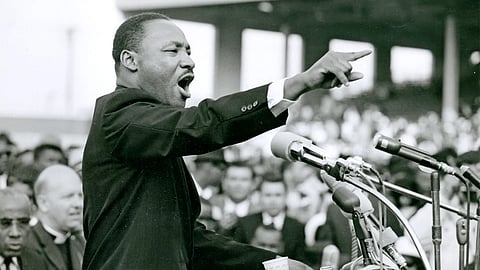

“We have guided missiles and misguided men” — Martin Luther King Jr.
This stark line from Martin Luther King Jr. captures a troubling imbalance in modern civilisation — rapid technological advancement without matching moral progress.
Delivered during his 1967 Christmas sermon on peace and later included in The Trumpet of Conscience, the quote reflects King’s broader concern that scientific progress had “outrun our spiritual power”.
The idea is simple but powerful:
“Guided missiles” symbolise humanity’s precision, innovation and technical mastery
“Misguided men” point to the lack of ethical direction guiding these capabilities
In essence, King warns that while humans have developed the tools to shape — and even destroy — the world, they have not evolved the moral clarity needed to use them responsibly.
The quote remains strikingly relevant in an era of advanced weapons, artificial intelligence and geopolitical tensions. It underlines a persistent question: can ethical judgment keep pace with technological power? It has special relevance against the context of the ongoing US-Israel war on Iran and Lebanon and the rising geopolitical tensions.
Martin Luther King Jr. was born on January 15, 1929, in Atlanta, USA, and emerged as the most prominent leader of the US civil rights movement. As a Baptist minister, he championed non-violent resistance inspired by Mahatma Gandhi, leading landmark campaigns such as the Montgomery bus boycott and the broader struggle against racial segregation in the United States.
He played a central role in historic events including the 1963 March on Washington, where he delivered his iconic “I Have a Dream” speech. King was awarded the Nobel Peace Prize in 1964 for his efforts to combat racial inequality through peaceful means, becoming one of the youngest recipients in history.
In his later years, King expanded his focus beyond civil rights to address poverty, economic justice and opposition to war, warning against what he described as the “triple evils” of racism, materialism and militarism. His growing critique of global conflict, including the Vietnam War, reflected his belief that peace and justice were inseparable.
He was assassinated on April 4, 1968, in Memphis while supporting a labour strike, but his legacy continues to influence movements for equality, justice and human dignity around the world.

