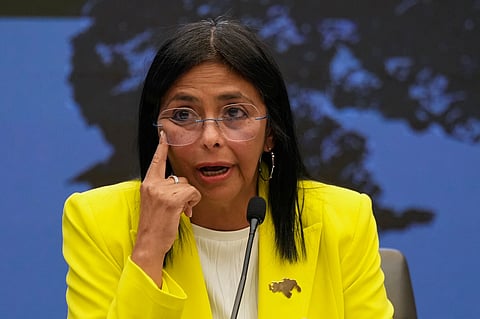

With the dramatic US capture of Venezuelan President Nicolás Maduro, power in Caracas has shifted quickly. Those who expected opposition leader and Nobel laureate Maria Corina Machado to take charge were surprised. Instead, Washington has backed a familiar face from within the old system — Delcy Rodríguez, the former vice-president and one of the most powerful figures of the Maduro era.
At 56, Delcy Rodríguez is no newcomer to power. A trained lawyer and a political hardliner, she has spent over two decades at the core of Venezuela’s ruling establishment. Known simply as “Delcy” at home, she has long been seen as a fierce loyalist and a skilled political survivor.
Her political identity is deeply shaped by personal history. Rodríguez is the daughter of Jorge Antonio Rodríguez, a Marxist guerrilla leader who died in custody in 1976 after being tortured by Venezuela’s intelligence services. His death turned him into a martyr for the left and later for Hugo Chávez’s movement. Delcy and her brother Jorge, now head of Venezuela’s National Assembly, have often said their rise was driven by a desire for justice — and revenge.
Rodríguez studied law in Venezuela and later specialised in labour law in France and the UK. Her return coincided with Hugo Chávez’s rise to power in 1998. Chávez saw promise in the young lawyer and steadily promoted her through key government roles, including in energy, foreign affairs and the presidential office.
After Chávez’s death in 2013, Nicolás Maduro accelerated her ascent. She became information minister, then Venezuela’s first female foreign minister, gaining global attention for her sharp attacks on the US and its allies. Controversies followed, including her attempt to force entry into a Mercosur summit in Argentina despite Venezuela’s suspension.
Her biggest domestic role came in 2017, when she headed the Constituent Assembly that stripped parliament of its powers, effectively locking in authoritarian rule. She was later appointed vice president and took charge of the economy, oil sector and central bank — making her one of the most influential figures in the country.
Internationally, Rodríguez is best known for the 2020 “Delcygate” scandal, when she secretly met a Spanish minister in Madrid despite an EU travel ban.
Now, as interim president, she stands at the centre of a fragile transition. Critics see her as part of the problem; supporters argue she offers continuity and control at a moment when a power vacuum could push Venezuela into chaos. For now, Delcy Rodríguez is the face of stability — and controversy — in a deeply uncertain Venezuela.
(Courtesy: dw.com)

