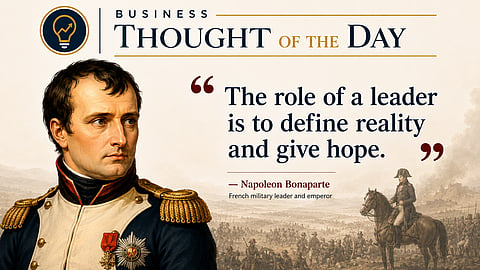

Every leader loves to talk about vision. Many enjoy speaking about the future, opportunities and success. But Napoleon Bonaparte believed that leadership begins somewhere much less glamorous—with reality.
"The role of a leader is to define reality and give hope." It is a remarkably simple idea. Before promising growth, profits or transformation, leaders must first understand the situation exactly as it is. Only then can they inspire people to move forward. Even after more than two centuries, this principle remains as relevant in boardrooms as it was on battlefields.
Napoleon Bonaparte was born in Corsica in 1769, just after the island became part of France. He did not come from a wealthy or powerful family. Instead, his talent, discipline and relentless work ethic helped him rise through the ranks of the French army during the turmoil of the French Revolution.
His military brilliance quickly became impossible to ignore. By the age of 30, he had become one of Europe's most celebrated generals. In 1804, he crowned himself Emperor of France, an extraordinary achievement for someone who had begun life as a relatively unknown officer.
Napoleon transformed France's administration, legal system and education. His Napoleonic Code became one of history's most influential legal frameworks, inspiring civil law systems in many countries. While his military victories made him famous, his administrative reforms arguably had an even longer-lasting impact.
Napoleon won dozens of major battles against larger and stronger armies. Victories at Austerlitz, Jena and Friedland are still studied in military academies around the world as examples of strategy, speed and decisive leadership.
His greatest strength was preparation. He studied every detail, understood his opponents, anticipated problems and made quick decisions when circumstances changed.
Business leaders often face different battlefields—markets instead of mountains, competitors instead of armies—but the underlying principles remain surprisingly similar. Good preparation, accurate information and swift execution continue to separate winners from the rest.
Napoleon's famous quote captures an important truth about leadership.
Employees can usually sense when leaders are pretending that everything is fine. Investors quickly recognise unrealistic promises. Customers notice when businesses ignore changing market conditions.
Strong leaders do not hide uncomfortable facts. They acknowledge challenges honestly, whether they involve slowing sales, rising costs or disruptive technologies.
But leadership cannot stop there. Once reality is understood, people also need confidence that improvement is possible. That is where hope comes in.
Hope without facts becomes wishful thinking. Facts without hope become discouragement. Successful leaders combine both.
Napoleon's story also carries an important warning. His extraordinary confidence gradually turned into overconfidence. His disastrous invasion of Russia in 1812 stretched his army beyond its limits. Harsh weather, logistical failures and fierce resistance devastated his forces.
Although he briefly returned to power, his final defeat at the Battle of Waterloo in 1815 ended his reign and reshaped European history.
His rise demonstrates the power of vision and execution. His fall reminds us that no leader is invincible. Even the greatest strategists must remain humble, listen to others and recognise changing realities.
Whether you run a family business, a start-up or a neighbourhood shop, Napoleon's advice still deserves attention.
Markets change. Technologies evolve. Consumer preferences shift. Economic cycles rise and fall. Ignoring reality never solves a problem.
At the same time, constantly talking about risks without offering a path forward drains confidence and motivation.
The most effective leaders do both. They face difficult truths with honesty and then provide people with a reason to believe that tomorrow can be better than today.
That balance—between realism and optimism—may be Napoleon Bonaparte's most enduring leadership lesson. It is one that every entrepreneur, manager and business owner can put into practice, regardless of the size of their organisation.

