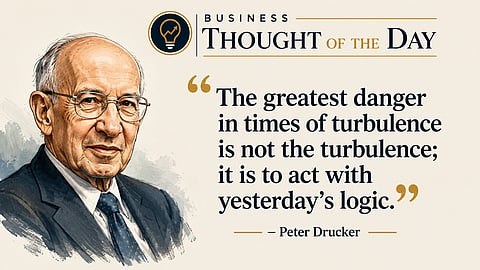

Peter Drucker, widely regarded as the father of modern management, believed that businesses fail not because change is difficult, but because leaders refuse to change with it. His observation, "The greatest danger in times of turbulence is not the turbulence; it is to act with yesterday's logic," has become one of the most enduring lessons in management. In today's business world, it is perhaps more relevant than ever.
Every generation of business leaders has faced disruption. Industrialisation reshaped manufacturing. Globalisation transformed trade. The internet revolution changed commerce forever. Today, artificial intelligence, automation, climate risks, geopolitical uncertainty and shifting consumer expectations are redefining industries at an unprecedented pace.
Many organisations mistakenly view turbulence as the greatest threat. They focus on external challenges such as inflation, trade barriers, technological disruption or market volatility. While these factors certainly create uncertainty, Drucker reminds us that the real danger lies within the organisation itself. Companies often cling to familiar business models, outdated processes and long-held assumptions even when the world around them has fundamentally changed.
History offers countless examples. Kodak invented digital photography but failed to embrace it because its leaders remained committed to the profitable film business. Nokia dominated mobile phones yet underestimated the shift to smartphones. Blockbuster dismissed the streaming revolution while Netflix reinvented entertainment. In each case, yesterday's logic became tomorrow's failure.
The same lesson applies to businesses of every size. A family-owned retailer cannot rely solely on foot traffic when customers increasingly shop online. Manufacturers cannot ignore automation if competitors are becoming more efficient. Financial institutions must adapt to digital payments, fintech innovation and AI-driven services. Even professionals must continually learn new skills to remain relevant.
Artificial intelligence illustrates Drucker's point perfectly. Some organisations see AI merely as another software tool, while others are redesigning entire business processes around it. The difference is not the technology itself but the willingness to rethink established ways of working. Companies that simply automate old processes may achieve incremental improvements. Those that reimagine their business models stand to gain a lasting competitive advantage.
For leaders, this quote is also a reminder to question their own thinking. Successful strategies eventually become outdated. Past achievements can create complacency. Markets evolve, customer behaviour changes and new competitors emerge unexpectedly. Wise leaders constantly ask whether the decisions that made them successful yesterday will still serve them tomorrow.
Adaptability does not mean abandoning every tradition or chasing every new trend. It means distinguishing between enduring values and outdated methods. Integrity, customer focus and quality remain timeless principles. The way organisations deliver these values, however, must evolve with changing circumstances.
Drucker's wisdom ultimately encourages intellectual flexibility. Businesses that question assumptions, encourage innovation and embrace continuous learning are far better equipped to navigate uncertainty than those that rely solely on past experience. In an era where change has become the only constant, success belongs not to the biggest or the oldest organisations, but to those willing to replace yesterday's logic with tomorrow's possibilities.

