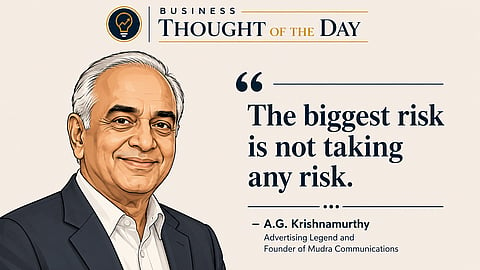

“The biggest risk is not taking any risk.” – AG Krishnamurthy, advertising guru
Most people associate risk with uncertainty, failure and loss. Entrepreneurs often spend countless hours trying to minimise risks before making a decision. Yet AG Krishnamurthy, one of India's most influential advertising pioneers, offered a different perspective. According to him, the greatest danger in business and life is not taking risks at all.
This simple statement carries a profound lesson for entrepreneurs, professionals and business leaders. Markets change, technologies evolve and consumer preferences shift constantly. Companies that refuse to adapt or hesitate to explore new opportunities often find themselves left behind. In contrast, those willing to take calculated risks are more likely to discover new markets, create innovative products and achieve sustainable growth.
Many business failures do not occur because leaders took bold decisions. They happen because leaders delayed decisions, avoided change or remained trapped in their comfort zones. Fear of failure can be more damaging than failure itself. A failed experiment often provides valuable lessons, but missed opportunities rarely return.
The quote is especially relevant for India's MSMEs and start-ups. Small businesses frequently face resource constraints and intense competition. The temptation is to play safe and avoid expansion, innovation or new investments. However, history shows that most successful enterprises were built by people who dared to take informed risks when others hesitated. Every major breakthrough, whether launching a new product, entering a new market or adopting a new technology, begins with a willingness to embrace uncertainty.
AG Krishnamurthy's own journey reflects this philosophy. Born in Andhra Pradesh, he started his career in advertising at a time when India's advertising industry was dominated by multinational agencies. In 1980, with limited resources but immense conviction, he founded Mudra Communications. It was a bold move in a highly competitive industry, and many would have considered it risky. Yet Krishnamurthy believed that Indian businesses deserved a strong home-grown advertising agency capable of competing with the best.
Under his leadership, Mudra Communications grew into one of India's largest and most respected advertising agencies. The company played a pivotal role in building several iconic Indian brands and demonstrated that an indigenous agency could match global standards. His entrepreneurial success inspired a generation of Indian business leaders and marketers.
Krishnamurthy's contributions extended beyond advertising. He was instrumental in strengthening professional standards within the industry and nurturing creative talent. He also established the Mudra Institute of Communications, Ahmedabad (MICA), which became one of India's premier institutions for strategic marketing, communications and advertising education. Through his books, speeches and mentoring, he encouraged countless young entrepreneurs to dream bigger and act boldly.
His message remains timeless. In today's fast-changing world, standing still can be riskier than moving forward. Whether in business, career or personal growth, progress often belongs to those willing to step beyond familiar boundaries.
Krishnamurthy, born in 1942, came from a modest background and built his career through determination, hard work and an unwavering belief in Indian talent. He began his professional journey in the textile and advertising sectors before finding his true calling in brand building. His rise from a small-town youth to one of India's most respected advertising professionals reflects the power of ambition, perseverance and self-belief. Throughout his career, he remained committed to nurturing young talent and encouraging entrepreneurs to dream big and pursue their goals with confidence.
The lesson from AG Krishnamurthy is that success is rarely achieved without risk. While every decision should be thoughtful and informed, fear should never become a barrier to action. The opportunities we seize often shape our future, but the opportunities we avoid may define our limitations.

