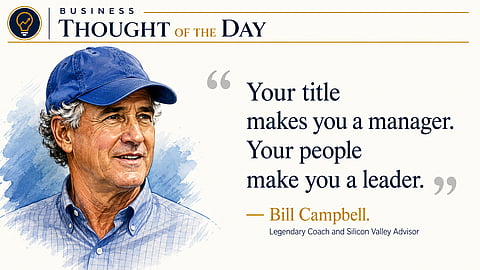

"Your title makes you a manager. Your people make you a leader."
— Bill Campbell (the coach behind Silicon Valley's greatest success stories).
You may not recognise Bill Campbell's name as readily as Steve Jobs or Elon Musk. Yet, for decades, some of the world's biggest technology leaders sought his advice before making crucial decisions. Campbell was the trusted mentor of Steve Jobs, Google's Eric Schmidt and Larry Page, Amazon's Jeff Bezos, and many other business icons. His influence was so profound that he came to be known simply as "The Coach."
Interestingly, Campbell didn't begin his career in technology. He played American football in college before becoming a football coach. Later, he moved into the corporate world, joining Kodak and eventually Apple, where he worked closely with Steve Jobs. He later served as CEO of software company Intuit and became one of Silicon Valley's most respected leadership advisers. Although he rarely appeared on magazine covers or social media, his ideas quietly shaped companies that changed the world. After his death in 2016, Google's Eric Schmidt, Jonathan Rosenberg and Alan Eagle captured many of his lessons in the bestselling book Trillion Dollar Coach, introducing Campbell's philosophy to a global audience.
Almost everyone becomes a manager at some stage in their career. A promotion brings a new designation, a larger team and greater responsibilities. But does it automatically make someone a leader?
Bill Campbell's answer was an emphatic no.
A company can hand you authority with a letter of promotion. Respect, however, cannot be handed over in an envelope. It has to be earned through everyday actions.
People willingly follow leaders who listen, encourage, support and stand beside them during difficult times. They may obey a manager because they have to. They follow a leader because they want to.
Think about the best boss you have ever worked with. Chances are, it wasn't their designation that made them memorable.
Perhaps they trusted you with important work. Maybe they gave you credit instead of taking it themselves. They may have defended you when things went wrong or challenged you to do better because they believed in your potential.
These are the moments that build leadership. Not corner offices, impressive business cards or organisational charts.
Campbell believed that genuine relationships were at the heart of every successful organisation. He spent as much time understanding people as he did discussing business strategy. His coaching wasn't about giving clever answers. It was about helping leaders bring out the best in others.
Modern organisations are flatter, faster and more collaborative than ever before. Young professionals expect managers who communicate openly, invite ideas and create opportunities for growth. Simply issuing instructions is no longer enough.
This is especially true as artificial intelligence takes over routine tasks. Human qualities such as empathy, trust, judgement and the ability to inspire teams are becoming more valuable, not less.
The managers who thrive in the years ahead will be those who develop people, not just processes.
Whether you run a multinational company, a family business, a start-up or a small retail shop, Campbell's message remains the same.
Ask yourself a simple question: if your designation disappeared tomorrow, would people still choose to follow you?
If the answer is yes, you are already on the path to becoming a true leader.
If not, remember that leadership isn't a position you achieve once. It's a relationship you build every day.

