
By Krishnabhaskar Mangalasserri
At a traffic signal in Kochi, I wait through a long red light. Three towering hoardings loom above me, each blaring the same political call: Mattaarund LDF allaathe? (Who else but LDF?). The Kerala chief minister’s image dominates them—familiar, confident, larger than life. I catch myself smiling and muttering, “If they say it one more time, I might actually forget it.”
Just metres away, an auto-rickshaw carries a competing message: Keralam Jayikkum, UDF Nayikkum (Kerala will win, UDF will lead). The same slogan flashes from LED lights on metro pillars, in mall corridors, and even in washroom corners.
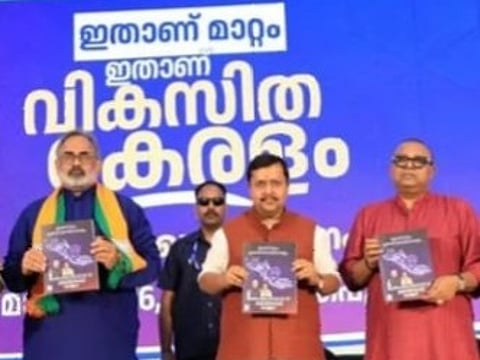
On the drive home, the radio joins the chorus—Marathathu ini marum (What hasn’t changed will now change), the BJP’s rallying cry, looping across FM stations. My television’s home screen, too, is an unmissable battlefield. Everywhere—visuals, jingles, pre-rolls, banners—politics invades spaces that advertising once modestly shared.
In the 2026 Kerala Assembly election campaign, visibility has become omnipresent, with attention emerging as the rarest commodity.
Kerala’s electoral battles have always been fiercely fought on ideological and interpersonal grounds. This time, the terrain is media.
From arterial roads to small-town junctions, nothing escapes the political gaze. Observers estimate the total campaign economy at ₹150–₹250 crore, spanning television, digital, and outdoor advertising—a quantum leap from past Assembly elections.
For a state with a 2.7 crore-strong electorate and 140 seats, this represents one of India’s most saturated per-capita campaign investments. Yet, behind the blazing hoardings and scrolling screens lies a fundamental question:
Can too much communication—and too much spending—dilute the very persuasion it seeks to build?
Macro snapshot
Electorate: 2.7 crore voters
Assembly seats: 140
Estimated campaign economy: ₹150–₹250 crore
Average daily ad exposure (urban voter): 20–40 political impressions
The ruling Left Democratic Front (LDF) pursued an “always-on” visibility strategy—maximising share of voice across every possible medium.
Media presence indicators:
Thousands of hoardings across the state (The Economic Times estimates Kerala leads India in per-capita political OOH density)
Intensive prime-time television bursts reinforcing leadership identity
Aggressive digital video campaigns tailored by geography and voter demographics
Estimated media spend:
Outdoor: ₹40–₹50 crore
TV & video: ₹30–₹50 crore
Digital: ₹20–₹30 crore
Total (indicative): ₹60–₹90 crore
On-ground patterns:
Kochi: Vyttila and Edappally junctions show layered hoarding clusters—multiple creatives repeating identical themes, leading to dominance but also creative fatigue
Thiruvananthapuram: A multi-platform push creates near nonstop exposure, especially in high-footfall zones
Malabar (Kozhikode–Kannur belt): Continuous banner corridors reflect deliberate saturation over depth
The result: high recall and familiarity—but diminishing novelty.
In sharp contrast, the United Democratic Front (UDF) is executing a lean, symbolic, authenticity-driven campaign—Kerala’s first experiment in “quiet branding.”
Highlights:
A sticker campaign under ₹1,000, leveraging virality and emotional resonance
Targeted ads in print and digital media emphasising leadership credibility and simplicity
Estimated spend: ₹25–₹35 crore
On-ground strategy:
Central Kerala & Kochi: Stickers, murals, and small-format messaging in everyday spaces—auto-backs, tea stalls, local shops
Thiruvananthapuram: Candidate-centric visibility focusing on trust over omnipresence
In a cluttered ecosystem, silence becomes visibility. The minimalist tone reads as authenticity to voters fatigued by sensory overload.
The National Democratic Alliance (NDA), aware of its limited base in Kerala, is opting for precision over pervasiveness.
Estimated spend: ₹25–₹30 crore
Tactics:
In urban hotspots such as Kochi and Thiruvananthapuram: crisp digital visuals and leader-led campaigns aligned with national messaging
In northern constituencies: focused outdoor messaging where demographics support winnability
This strategy maximises cost-efficiency and constituency-level recall, but trades off statewide visibility.
At first glance, the formula appears simple:
More visibility = more recall = more votes.
But marketing science and behavioural economics suggest otherwise.
1. Advertising wear-out
Repeated exposure builds familiarity, but eventually leads to neglect—and even irritation. In Kerala’s current cycle, 30+ daily impressions risk pushing messaging from persuasion to fatigue.
2. Clutter and contrast
When one player dominates every surface, even modest counter-messages begin to stand out. UDF’s low-cost design becomes aesthetic relief in a crowded visual landscape.
3. The taxpayer perception risk
In Kerala’s politically aware society, visibility invites scrutiny. The common question—heard from campuses to offices—is:
“Who’s paying for all this?”
Even compliant spending can trigger scepticism about governance priorities.
4. Message dilution
Multi-platform messaging often fragments communication. When visuals repeat identity without substance, recall weakens. Voters remember the face, but forget the message.
5. Psychological reaction
Kerala’s electorate—literate, opinionated, and argumentative—often resists overt persuasion. Excessive messaging can trigger subconscious resistance, turning attention into rejection.
LDF: High-spend, saturation visibility
Strength: Dominant recall
Risk: Fatigue and perception of excess
UDF: Low-cost, minimalist outreach
Strength: Authenticity and contrast
Risk: Limited reach
NDA: Targeted, data-driven campaigns
Strength: Efficient local engagement
Risk: Lower mass resonance
Kerala’s 2026 election offers lessons beyond politics:
Attention is finite; when everything speaks, silence stands out
Minimalism can outperform scale in dense media environments
Perception of spending matters as much as spending itself
Differentiation now depends on restraint, not amplification
This campaign season may redefine what effective communication means in media-saturated democracies.
In an age where everyone is shouting, the mind listens to those who whisper.
Beyond a point, advertising stops informing—it begins to interrogate itself, prompting voters to ask not what is being said, but why it is being said so loudly, and who can afford to keep saying it.
All figures are industry estimates based on public-domain reports and campaign observation
Official disclosures will be available post-election through the Election Commission of India
In the final analysis, Kerala’s 2026 campaign may be remembered less for its slogans and more as a case study in communicative saturation—where political marketing crossed into sensory overload, and visibility became indistinguishable from noise.
(Krishnabhaskar Mangalasserri is a management trainer and consultant; he is Professor of Marketing at SCMS Cochin School of Business.)

