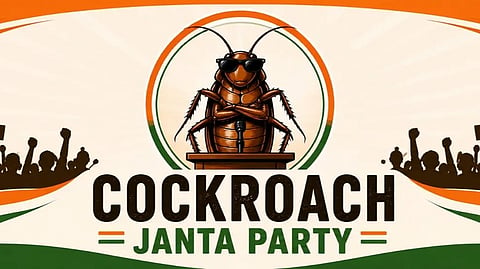

A satirical online movement built around one of the world’s most disliked insects has unexpectedly become the latest talking point in Indian politics. What began as a joke after controversial remarks by India’s Chief Justice has quickly evolved into a viral digital phenomenon, drawing millions of followers, endorsements from opposition leaders and intense debate over youth frustration, unemployment and political alienation.
The movement, called the Cockroach Janta Party (CJP), takes its name from the hardy insect often associated with survival in hostile conditions. The label emerged after Chief Justice Surya Kant, during a court hearing, allegedly compared unemployed young people drifting towards journalism and activism to “cockroaches” and “parasites”. Though he later clarified that he was referring only to individuals with “fake and bogus degrees”, the comments had already ignited outrage and mockery online.
Within days, social media users transformed the insult into a badge of defiance. Memes flooded the internet, hashtags such as #MainBhiCockroach (“I too am a cockroach”) began trending, and a fictional political outfit was born.
The CJP’s name deliberately parodies Bharatiya Janata Party. While critics accuse the BJP government of weakening press freedom and civil liberties, the ruling party strongly rejects such allegations.
Unlike traditional political parties, however, the CJP is not contesting elections or building grassroots structures. It is primarily an online satire movement fuelled by humour, memes and political frustration. Its mock membership criteria include being unemployed, lazy, chronically online and capable of “ranting professionally”.
The movement was launched by Abhijeet Dipke, a 30-year-old political communications strategist and student at Boston University. Dipke previously worked with the Aam Aadmi Party (AAP), known for its aggressive social media campaigns and anti-corruption roots.
Dipke says the idea started casually. “I thought we should all come together, maybe just start a platform,” he said.
What followed surprised even its creators. Thousands signed up through a Google form linked on the CJP website, while opposition politicians including Akhilesh Yadav, Mahua Moitra and Kirti Azad publicly engaged with the movement online.
The party’s rapid growth became even more striking when its Instagram account crossed 10 million followers, overtaking the BJP’s official Instagram handle, which has about 8.7 million followers. Its X account, however, was later withheld in India following what the platform described as a legal demand.
The movement has also spilled beyond social media. Young supporters have appeared at protests and clean-up campaigns dressed as cockroaches, theatrically embracing the insult that triggered the trend.
Despite the online frenzy, there is little indication so far that the CJP will translate into real electoral influence. India’s political landscape continues to be dominated by major national parties such as the BJP and Congress, both of which possess enormous organisational networks and millions of active workers.
Still, the popularity of the CJP highlights a deeper unease among many young Indians. India has one of the world’s youngest populations, with nearly half of its 1.4 billion people under the age of 30. Yet surveys suggest many young citizens feel disconnected from formal politics.
A recent study found that 29 percent of young Indians avoid political engagement entirely, while only 11 percent are members of political parties.
The frustration is rooted partly in economic realities. Although India remains one of the world’s fastest-growing major economies, anxieties over jobs, inequality and rising living costs continue to persist. For many young graduates, higher education no longer guarantees stable employment or upward mobility.
Dipke argues that younger generations increasingly distrust traditional political structures and prefer to communicate through internet culture, humour and irony.
The CJP website reflects that mood. It describes itself as “the voice of the lazy and unemployed”, claims to have “zero sponsors” and “one stubborn swarm”, and invites people “tired of pretending everything is fine” to join.
Behind the jokes, however, lie serious themes: demands for accountability, media reform, electoral transparency and greater political representation.
The blending of humour and politics is not unique to India. Around the world, anti-establishment movements have increasingly used satire and entertainment to mobilise support. But India’s version feels distinctly internet-driven — shaped by memes, burnout and digital disillusionment.
Whether the Cockroach Janta Party survives or fades quickly, it has already achieved something unusual: it has briefly given many young Indians a language to express their anger, exhaustion and sense of exclusion from mainstream politics.

